
Reading Viral Genomes
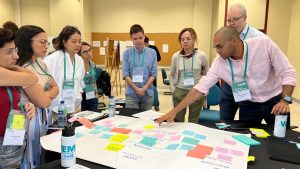
text: Katrine Anker-Nilssen photos: CERI Media & Supplied
For many researchers working with viral genomes, the challenge is no longer generating sequence data but rather understanding how to analyse and interpret it meaningfully. And this is the exact gap that the Virus Evolution and Molecular Epidemiology (VEME) Workshop is designed to address.
Hosted annually by leading international researchers in evolutionary genomics and molecular epidemiology, and supported through networks linked to the Centre for Epidemic Response and Innovation (CERI) at Stellenbosch University, VEME focuses on how genomic data can be translated into real-world public health insight from understanding outbreak dynamics, to tracking viral evolution and transmission patterns.
Over six intensive days, participants work through end-to-end analytical workflows used in infectious disease genomics. Rather than approaching phylogenetics as abstract theory, the workshop emphasises how tools and models are applied in practice to address real-world public health challenges.
Participants begin with the fundamentals of building phylogenetic trees from sequence data, using widely adopted tools such as IQ-TREE and BEAST. Alongside learning how to run analyses, the workshop places strong emphasis on understanding model selection, uncertainty, and the biological meaning behind different evolutionary assumptions.
Professor Philippe Lemey (pictured left), a Belgian evolutionary biologist and bioinformatician based at KU Leuven, has been teaching at VEME for more than two decades. I have been involved since I first participated in 2001. For over 10 years, I have organised the hypothesis testing module at VEME, he says.
Internationally recognised for his work in phylogenetics, molecular evolution, and infectious disease dynamics, Prof Lemeys research focuses on developing computational and statistical approaches to understand how viruses evolve and spread.
For this years VEME workshop, which will take place from September 6 to 11 at Bertha Retreat in Stellenbosch, one of the most important skills he hopes participants will take away is the ability to navigate complex Bayesian statistical analyses for phylodynamics. Rather than treating Bayesian phylodynamics as a black box, the workshop should provide participants with a sufficient understanding of its inner workings, as well as the background and confidence needed to use these methods in practice, he explains.
The analytical approaches taught at VEME have become increasingly important in modern outbreak response. During epidemics, phylogenetic and phylodynamic analyses can help researchers understand how pathogens are spreading, identify emerging variants, reconstruct transmission patterns, and support public health decision-making in near real time. As genomic sequencing capacity continues to expand globally, the ability to interpret and contextualise these datasets has become just as important as generating them.
The workshop therefore moves beyond tree building into more advanced evolutionary hypothesis testing, where participants explore questions around viral spread, adaptation, and transmission dynamics. Practical examples mirror real research problems such as determining whether a virus is evolving under selective pressure, or reconstructing the timing and geographic movement of outbreaks.
A major focus throughout the course is workflow integration. Participants are guided through the full analytical process, from sequence alignment and quality control to phylogenetic reconstruction and interpretation within public health and research settings.
For participants such as Ambroise Ahouidi, a Senegalese researcher specialising in malaria genomics at the Institut de Recherche en Santé, de Surveillance Épidémiologique et de Formation (IRESSEF) in Dakar, VEME provides an opportunity to strengthen the analytical skills increasingly needed for genomic surveillance across Africa.
Ahouidis work focuses on malaria parasite diversity, transmission dynamics, immunity, and antimalarial drug resistance in West Africa, using genomic and molecular approaches to support disease surveillance and public health responses.
Generating genomic data is becoming increasingly accessible, but interpreting that data correctly remains a major challenge, notes Ahouidi. Workshops like VEME are important because they help researchers develop the analytical skills needed to translate genomic information into meaningful public health insight.
He adds that understanding evolutionary dynamics and transmission patterns is becoming increasingly important for infectious disease surveillance across the continent. Training in these analytical approaches strengthens our ability to respond more effectively to emerging disease threats in Africa, notes Ahouidi.
For CERI, workshops such as VEME form part of a broader commitment to strengthening genomic surveillance and bioinformatics capacity across Africa. By bringing together researchers, facilitators, and participants from multiple countries and disciplines, the workshop helps build the analytical expertise and collaborative networks needed to support future outbreak preparedness and response.
As genomic surveillance becomes increasingly central to epidemic preparedness, these initiatives are helping build the expertise needed to interpret complex pathogen data rapidly, rigorously, and in ways that can meaningfully support public health action.
News date: 2026-06-03
Links:
KRISP has been created by the coordinated effort of the University of KwaZulu-Natal (UKZN), the Technology Innovation Agency (TIA) and the South African Medical Research Countil (SAMRC).


Location: K-RITH Tower Building
Nelson R Mandela School of Medicine, UKZN
719 Umbilo Road, Durban, South Africa.
Director: Prof. Tulio de Oliveira