
Urobo Biotech wins big at SWEAT Africa 2026 - the gem - Feb 2026
Environmental Responsibility aligned with Commercial Viability
text: Katrine Anker-Nilssen photos: SWEAT Africa & Supplied
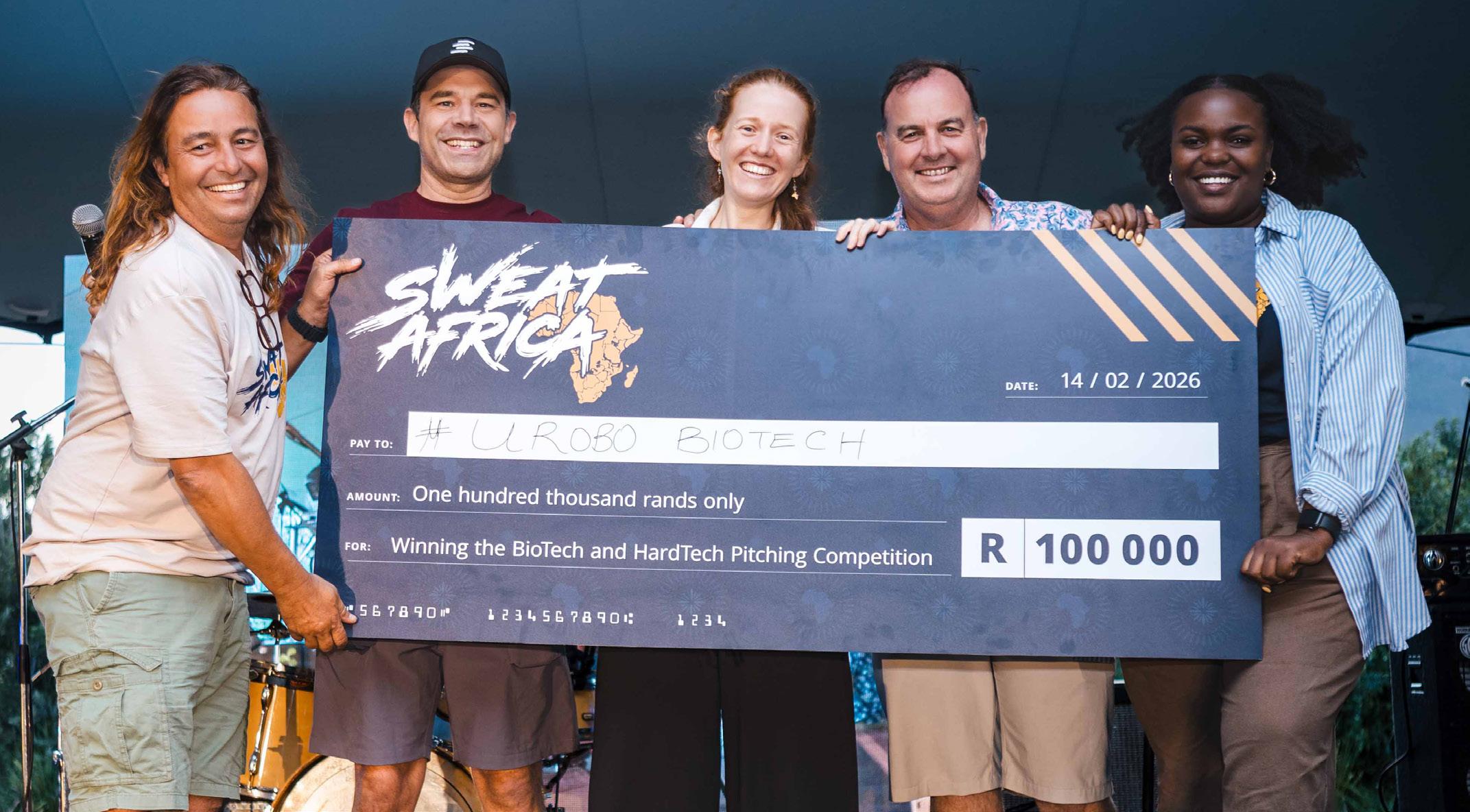
On 14 February 2026, under the main tent at Bertha Retreat between Stellenbosch and Franschhoek, Africa’s most promising biotech and hardtech founders took to the stage for the final of the SWEAT Africa Pitch Competition. With a winner-take-all R100 000 cash prize on the line, the stakes were high – and the standard even higher.
By the end of the evening, it was Urobo Biotech that walked away with the grand prize.
Launched as part of the inaugural SWEAT Africa festival (13–14 February 2026), the competition was designed to spotlight frontier technologies with real commercial potential. More than 100 startups and over 50 investors attended the festival, underscoring its ambition to position Africa as a serious force in deep-tech innovation. Finalists were selected through a mandatory BioTech & HardTech side event facilitated by Stellenbosch University LaunchLab in partnership with Stellenbosch Network, with 10 startups qualifying and the top contenders advancing to the main stage.
From a continent-wide pool of entries to a formidable Top 10, the competition showcased the depth of African innovation. The Top 4 finalists – Fetch Energy, Khaya HealthTech, NanoPula, and Urobo Biotech – tackled challenges ranging from mining waste and wave-generated power to medical devices and bioplastics waste management.
For Dominique Rocher, co-founder and COO of Urobo Biotech, the win represented far more than a cheque. “Seeing that three of the top four startups were represented by women was a powerful signal that women in STEM are not only stepping up, but being recognised at high levels of African entrepreneurship,” she says. “That meant a lot.”
For Urobo itself, the moment was equally significant. “It showed that our technology and business model can stand up to scrutiny from a high-profile judging panel and be acknowledged for its real scientific and commercial value. It was validation, both personally and professionally, that we are building something globally relevant from Africa.”
Building a Circular Chemical Future
Urobo Biotech is tackling a fast-growing global problem: bioplastic-rich waste that current infrastructure cannot properly process. While bioplastics are often marketed as sustainable alternatives, waste systems have not adapted quickly enough. As a result, much of this material is still incinerated or landfilled, undermining its environmental promise and creating inefficiencies for waste operators.
“Urobo Biotech uses advanced enzymes and microbes to convert bioplastic-rich waste into high-value chemicals and fuels,” Dominique explains. “As bioplastics scale globally, waste infrastructure hasn’t adapted fast enough.”
But the judges, she believes, responded to more than just the environmental argument. “I believe it was the combination: credible science, a large market opportunity, and a clearly framed economic pain point. We’re not just solving plastic pollution, we’re improving waste operators’ margins while creating a circular chemical market.”
It is this integration – environmental responsibility aligned with commercial viability – that sets Urobo apart. “We are part of a generation that can’t afford to repeat past mistakes in materials and waste systems,” says Dominique. “It’s not enough to voice concern about climate change and plastic pollution. We must actively design better systems. Urobo exists to turn that responsibility into action.”
The road to the main stage was not without pressure. During the competition, the toughest questions centred on scaling timelines and commercialisation risk –familiar challenges for biotech ventures, where five- to ten-year paths to market are common. “Initially, we assumed similar timelines,” Dominique admits. “We now have plans to begin enzyme sales this year and complete demo-scale validation in 2027.”
In the days following SWEAT, the team refined its execution roadmap and strengthened strategic partnerships. “Over the past week, we’ve refined a detailed execution roadmap for demo-scale deployment and strengthened strategic partnerships, bringing us significantly closer to unlocking a $23 million conditional term sheet.”
Leadership at the Intersection of Science and Business
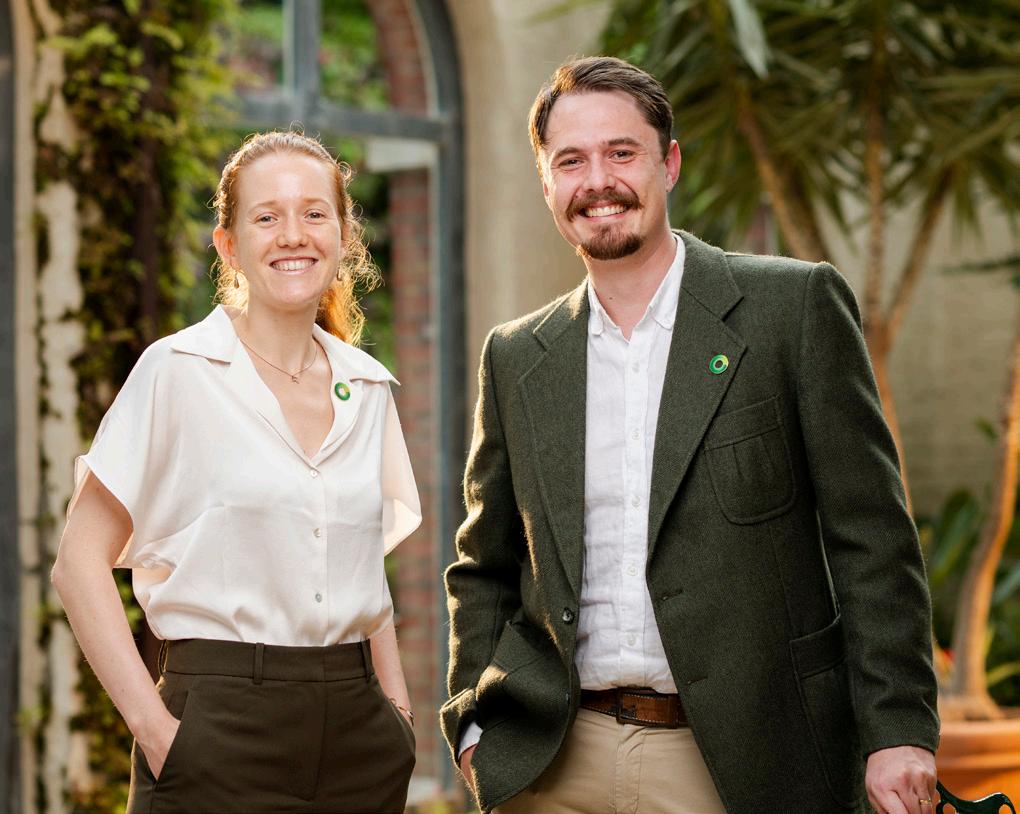
Dominique formally serves as COO, while Dr Wessel Myburgh (pictured below with Dominique), the main inventor behind the technology, is CEO. Dominique’s background in socio-entrepreneurship and global business development positions her to lead partnerships, secure off-takers, support fundraising, and manage operations. At the same time, she is completing her PhD on the company’s technology. “As an early-stage startup, we wear multiple hats,” she says. “What truly sets us apart is our complementary thinking. Dr Myburgh brings deep technical mastery and unwavering realism, while I tend to push boundaries and explore bigger opportunities. Together, we balance ambition with grounded execution.”
Converting Momentum into Growth
SWEAT Africa provided more than visibility – it delivered access.
Urobo is currently raising a $425,000 pre-seed round and aims to close by May 2026. “SWEAT Africa provided a valuable platform to connect with new investors while also updating previously engaged ones on our progress,” Dominique says. “Our focus now is converting these conversations into concrete term sheets in the coming weeks.”
Beyond capital, the company is pursuing strategic local partnerships to support demo-scale validation and strengthen its footprint within Africa’s waste and circular economy ecosystem. “The calibre of founders
News date: 2026-03-01
Links:
KRISP has been created by the coordinated effort of the University of KwaZulu-Natal (UKZN), the Technology Innovation Agency (TIA) and the South African Medical Research Countil (SAMRC).


Location: K-RITH Tower Building
Nelson R Mandela School of Medicine, UKZN
719 Umbilo Road, Durban, South Africa.
Director: Prof. Tulio de Oliveira