
Mapping Hepatitis Inequities
Despite major advances in vaccination and treatment, hepatitis B virus (HBV) and hepatitis C virus (HCV) together still claim over one million lives annually. Yet the global effort to understand these viruses genomically â tracking genotypes, resistance mutations, and disease burden â remains critically uneven. A new study published as a preprint with The Lancet, led by researchers from CERI, KRISP, the Francis Crick Institute, and the Africa Health Research Institute (AHRI), exposes the depth of those inequities and offers a powerful new tool to address them: the open-access Hepatitis Dashboard. The platform integrates more than 14,000 sequences from 141 countries with Global Burden of Disease estimates, enabling real-time visualisation of where genomic surveillance is failing to match the populations most at risk.
What the Paper Says
The surveillance gap is stark â and skewed:
The team reviewed existing viral genomic repositories and found them structurally limited: sequence availability is geographically concentrated in China and the United States, while countries carrying the greatest disease burden â including Nigeria, India, and many nations across Africa and the Western Pacific â are severely undersampled. Certain viral genotypes are almost invisible in global databases: HBV genotype E, which predominates in sub-Saharan Africa, and HCV genotypes 5 and 8 are critically underrepresented, hampering the ability to track transmission, monitor drug resistance, and tailor treatment responses in the regions that need it most.
A new metric to measure whatâs missing:
One of the studyâs key contributions is the development of a burden-adjusted sequencing coverage metric â a tool that measures not just how many sequences exist from a country, but how representative that sequencing effort is relative to the actual disease burden. By this measure, some of the worldâs highest-burden nations are also the least represented in genomic datasets, a misalignment that undermines both research and public health decision-making. The team also identified circulating drug resistance mutations across the integrated dataset â findings with direct implications for treatment programmes in settings where second-line therapies may be limited or unavailable.
The Hepatitis Dashboard:
Built on the integration of 10,996 HBV and 3,533 HCV whole-genome sequences from public repositories, combined with Global Burden of Disease estimates, the Hepatitis Dashboard is an open-access interactive platform covering sequences from 141 countries. It is designed to be continuously updated and reproducible, giving researchers and public health agencies a real-time view of where genomic coverage is adequate â and where it is dangerously thin. All data and source code are publicly available on GitHub.
2030 elimination targets at risk:
The WHO has set 2030 as the target for eliminating hepatitis B and C as public health threats. The paperâs projections are sobering: on current trajectories, neither HBV nor HCV are on track to meet those goals. The dashboard is intended to support the evidence-based sampling strategies and equitable funding decisions needed to change that course.
Read the full paper, and list of authors, here
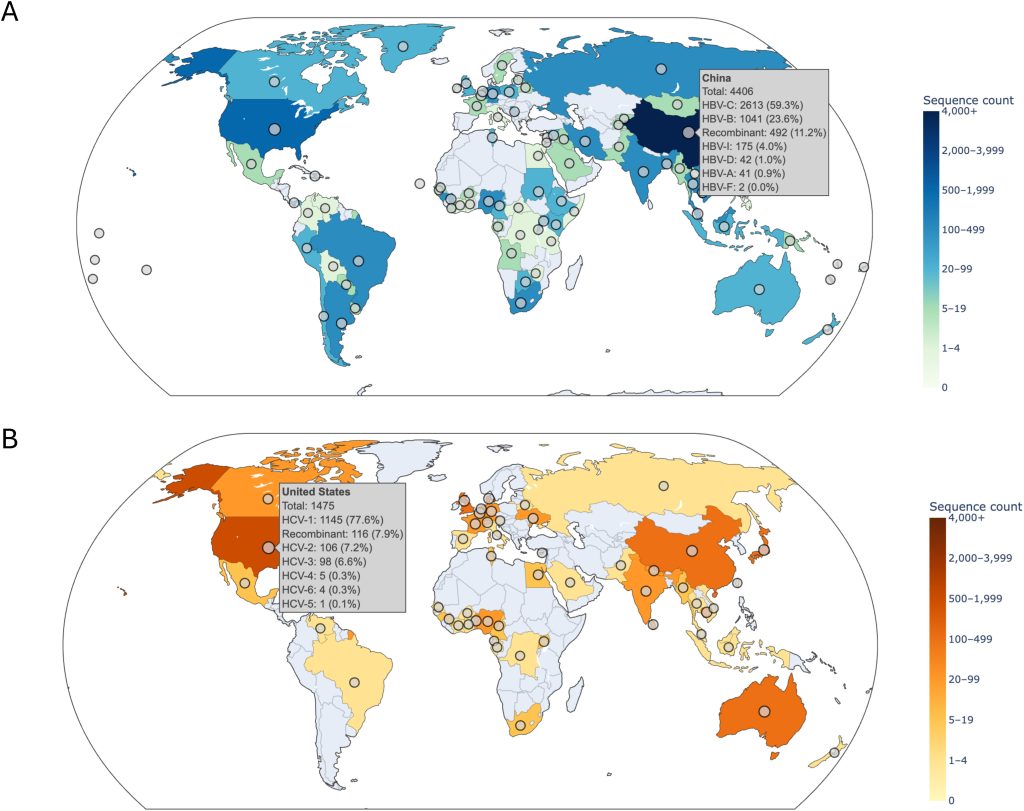
ABOVE: Global distribution of HBV and HCV WGS by country. Choropleth maps show the number of publicly available HBV (A) and HCV (B) genomes, coloured by sequence count per country. Genotype distributions are represented by overlaid dots, which display detailed breakdowns on hover in the interactive dashboard.
News date: 2026-07-30
Links:
KRISP has been created by the coordinated effort of the University of KwaZulu-Natal (UKZN), the Technology Innovation Agency (TIA) and the South African Medical Research Countil (SAMRC).


Location: K-RITH Tower Building
Nelson R Mandela School of Medicine, UKZN
719 Umbilo Road, Durban, South Africa.
Director: Prof. Tulio de Oliveira