
PEPFAR-supported HIV Treatment Declines
A new study published in Nature Health, co-authored by Prof Frank Tanser, provides one of the first empirical assessments of changes in PEPFAR-supported HIV treatment following major disruptions to U.S. foreign assistance. Across all 55 PEPFAR-supported countries, approximately 1.97 million fewer people were reported as receiving PEPFAR-supported antiretroviral treatment in 2025 than in 2024 – a decline of 10.2%.
South Africa saw the largest absolute decline in direct PEPFAR-supported treatment, with approximately 1.73 million fewer people receiving this form of support. This was largely offset by an increase of around 1.64 million people reported as benefiting from PEPFAR’s broader, system-level support, resulting in a net decline of approximately 95,000 people receiving some form of PEPFAR treatment support.
“The figures suggest that the way PEPFAR supports HIV care has changed significantly,” says Prof Tanser. “The key concern is whether South Africa’s health system can maintain uninterrupted, high-quality HIV treatment and support as direct external assistance decreases.” He says protecting the progress already made will require stronger domestic funding and health-system capacity as PEPFAR withdraws its support, alongside close monitoring of treatment access, retention in care, and viral suppression.
ABSTRACT
Here we analysed recently released treatment data from the US President’s Emergency Plan for AIDS Relief (PEPFAR) programme following a year of disruption. Globally (n?=?55 countries), the programme reported approximately 1.97 million (?10.2%) fewer individuals receiving PEPFAR-supported antiretroviral treatment in fiscal year (FY) 2025 as compared with FY2024. FY2025 treatment budget execution declined by approximately 8 percentage points compared with the historical mean.
Within a subset of countries selected for further analysis (n?=?26), most experienced absolute declines in PEPFAR-supported treatment and 14 deviated negatively from pre-2025 trends. For South Africa, PEPFAR reported a decline of 1.73 million individuals on direct PEPFAR-supported treatment and an increase of 1.64 million individuals on treatment benefitting solely from the programme’s broader support to health systems, yielding a net treatment loss of 94,881 (?1.8%) individuals. Outstanding questions remain regarding the drivers, persistence and broader impact of PEPFAR-supported treatment shifts, underscoring the need for timely programme data.
Read the full paper, and list of authors, here
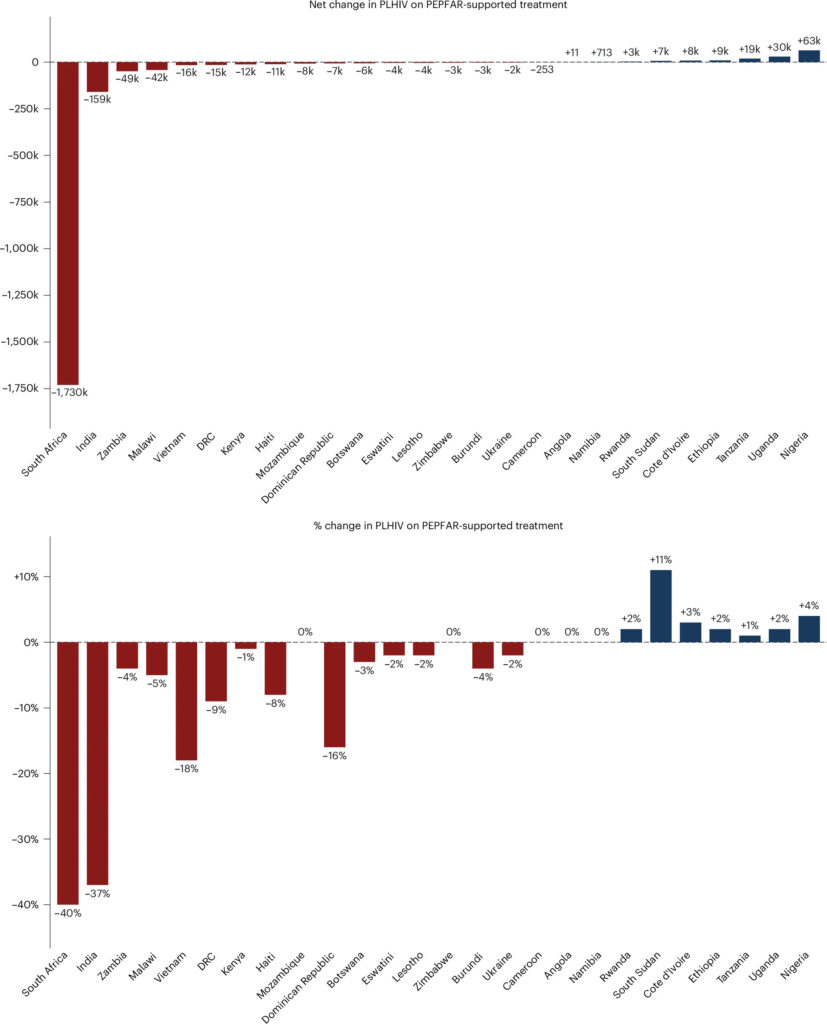
Figure (above):
Top: absolute net change in PLHIV on PEPFAR-supported treatment.
Bottom: corresponding percentage change. Countries are ordered by magnitude of absolute change. Bars extending below zero indicate net declines; bars extending above zero indicate net gains. Values exceeding 1,000 are rounded to the nearest thousand; percentage changes are rounded to the nearest whole percent. No error bars are shown as values represent reported programmatic totals rather than estimates.
News date: 2026-09-03
Links:
KRISP has been created by the coordinated effort of the University of KwaZulu-Natal (UKZN), the Technology Innovation Agency (TIA) and the South African Medical Research Countil (SAMRC).


Location: K-RITH Tower Building
Nelson R Mandela School of Medicine, UKZN
719 Umbilo Road, Durban, South Africa.
Director: Prof. Tulio de Oliveira