
Exploring the Future of Multi-Omics
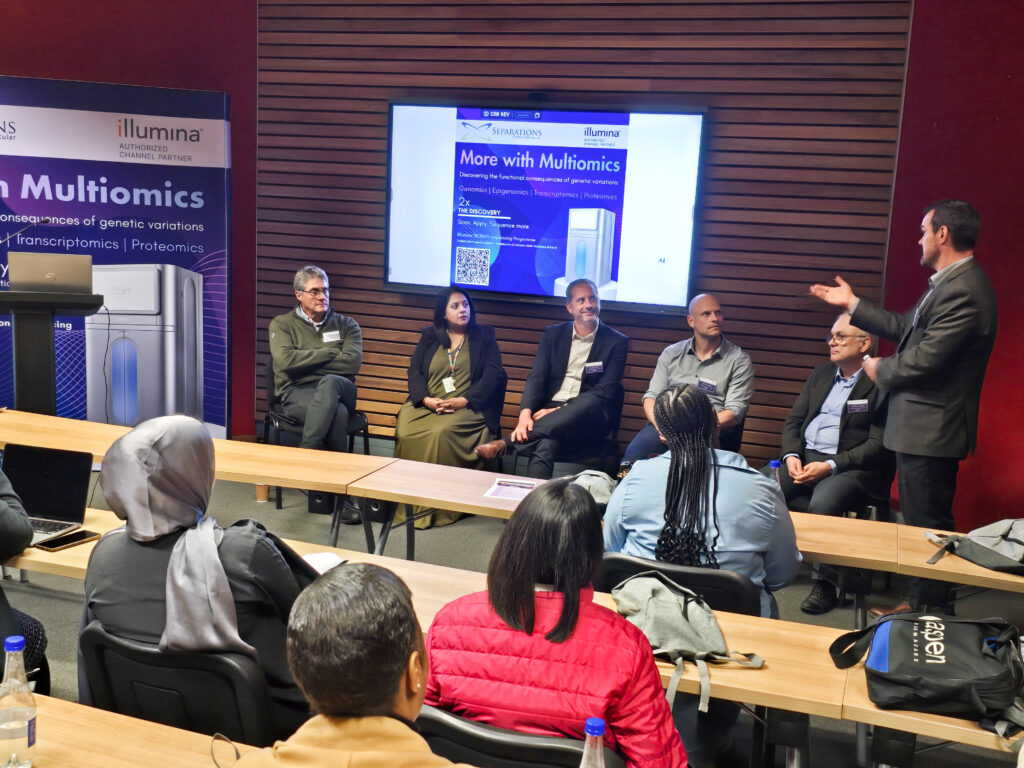
KRISP recently welcomed researchers, scientists and industry experts to Durban for the regional Separations Multi-Omics Showcase Roadshow, hosted in partnership with Illumina. The event provided an opportunity to explore the rapidly evolving world of multi-omics and the technologies helping researchers move beyond individual layers of biological data towards a more integrated understanding of complex biological systems.
The programme showcased developments in next-generation sequencing, single-cell analysis, spatial biology and proteomics, while bringing together an impressive line-up of speakers from across the genomics, clinical research and life sciences communities.
Representing KRISP as the regional speaker, Dr Jennifer Giandhari reflected on what a decade of genomic surveillance has looked like in practice and the important role that scientific partnerships and technological innovation have played in supporting this journey.
The event also featured presentations from Dr Lukas Paul on the expanding possibilities of multi-omics, Prof Michael Pepper on molecular pathogenesis and biomarker discovery, Dr Theo Heyns on the translation of sequencing data into meaningful biological insights, and Dr Gary Prescott, who provided a glimpse into the future of proteomics.
For KRISP Lab Manager Dr Sureshnee Pillay, the event offered valuable insight into technologies that could shape future research. “The event was very worthwhile. They introduced new and fascinating technologies, such as the TruPath genome solution, which will make a large impact on how we approach our research going forward.”
Dr Giandhari echoed the value of bringing the scientific community together, describing the opportunity to host experts from across genomics, proteomics and clinical research for a full day of science in Durban as “genuinely special”.
Beyond the presentations, the Ask the Experts session encouraged open discussion and engagement between researchers and technology specialists. For KRISP, the showcase highlighted the importance of continued collaboration and capacity building as multi-omics technologies open new avenues for scientific discovery.
With genomics, transcriptomics, proteomics and other biological data increasingly being studied together, the future of multi-omics promises richer insights and new possibilities for research.
text & photo: Paul Harris
News date: 2026-09-03
Links:
KRISP has been created by the coordinated effort of the University of KwaZulu-Natal (UKZN), the Technology Innovation Agency (TIA) and the South African Medical Research Countil (SAMRC).


Location: K-RITH Tower Building
Nelson R Mandela School of Medicine, UKZN
719 Umbilo Road, Durban, South Africa.
Director: Prof. Tulio de Oliveira