
When Ecology and Epidemiology Meet
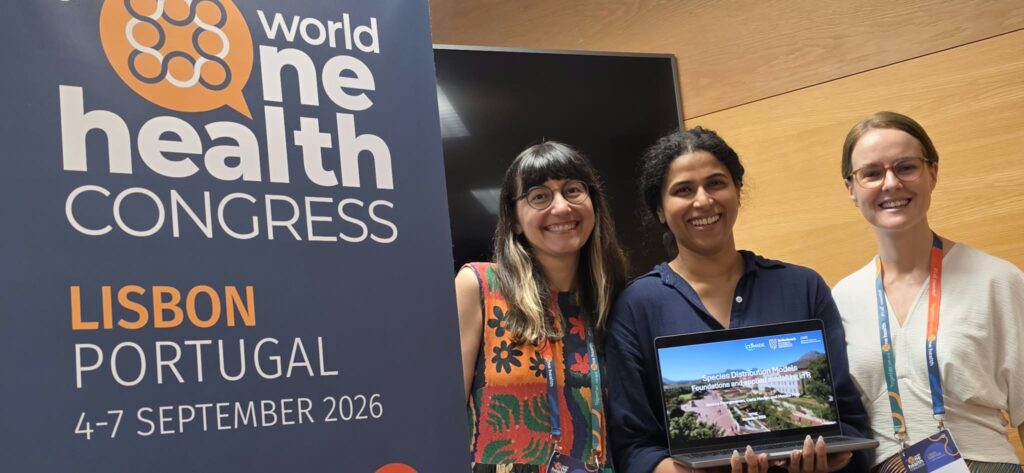
The World One Health Congress brings together experts from around the world to advance collaboration at the intersection of human, animal, and environmental health. The ninth edition ran from 4–7 September 2026 in Lisbon, Portugal.
What struck me about this year’s framing was how much of it was about the connective tissue rather than the disciplines themselves. Less “here is what veterinarians do, here is what epidemiologists do”, and more “why are these conversations still happening in separate rooms?”
CERI had a small but busy presence. Prof Carla Mavian and Dr Monika Moir were both there, and the three of us ran the species distribution modelling workshop together. Both are also co-authors on the Andes virus work I presented, so it was a rare chance to have a whole project in one room at one time, rather than spread across a thread of emails and time zones.
That emphasis on crossing disciplinary boundaries resonated with all three of us. For Monika, the Congress demonstrated the value of bringing very different perspectives together.
“It is a space where science, policy and practice intersect around the shared challenges of emerging infectious diseases, antimicrobial resistance, environmental change and global health,” she says. “The breadth of expertise, backgrounds and perspectives represented at the Congress was outstanding and created an ideal platform for multilateral engagement and genuinely transdisciplinary research collaborations.”
Carla was struck by a similar message in one of the first keynotes. “Instead of destroying silos, let’s build bridges across them,” she says. “We each have our own expertise – our ‘silo’ – and the important thing is building bridges that allow us to collaborate across them.”
Where Andes virus could spill over
My poster covered work on Andes virus and its rodent reservoir across South America. Andes virus is the only hantavirus with documented sustained human-to-human transmission, and the cruise ship outbreak earlier this year put it back on the international radar, but the conditions that permit ecological transmission are still poorly understood.
We modelled the rodent host and the virus separately, then together. Temperature turned out to dominate, and not in a simple “more is better” way: extremes at both ends pushed suitability down. Proximity to waste sites and land cover followed, while rainfall and humidity had less of an impact.
More usefully, the host model and the virus model disagree. Reservoir presence alone does not tell you where the virus is, which matters for anyone designing surveillance around the rodent. And when we laid suitability over where people live, build, and travel, the population inside suitable areas had climbed over the past decade while the ecological niche itself stayed put. People are moving into the risk rather than the risk moving towards them.
The result that generated the most conversation, though, was a timing one. In Argentina, suitability and reported cases are both seasonal and sit roughly half a cycle out of phase, so comparing them month against month makes the relationship look negative, and you would write the signal off. Shift suitability forward and it reverses, with the strongest alignment landing around five months ahead of cases. Chile shows the same shape.
SDM workshop
The workshop was a hands-on introduction to species distribution modelling for diseases and their vectors, run with Carla and Monika. The premise was to get people from a blank R session to a finished, interpretable map in one sitting, with no prior experience assumed, using open occurrence records and freely available climate layers for Aedes aegypti in Brazil.
What I wanted people to leave with had little to do with the mosquito. The boring decisions are the ones that matter: where you place your background points changes the map more than any model setting you will ever tune, and we compared three strategies side by side and watched the answer move. We wanted participants to leave with the important concepts around SDMs and enough tools to be able to experiment on their own later on.
What I took home
The part I valued most was a workshop where we discussed the needs and ways around bridging the gap between ecology and epidemiology. Most of the room does not build species distribution models, so the questions came from the other side of that boundary: where an ecological model fits into an epidemiological question, and what would need to be true before anyone acted on one. That conversation sits at the centre of One Health work, and it is the one I want to keep having.
My background in statistical ecology has shaped my interest in where disease vectors occur, how their distribution influences the risk of human infection, and how early we can anticipate outbreaks. These questions sit at the intersection of ecology and public health, where methods for integrating knowledge across disciplines are still evolving.
I would like to develop modelling approaches that bring ecological processes and human health outcomes together from the outset, and my Andes virus lag analysis is an early step in that direction.
For me, the value of meetings like the World One Health Congress lies in the opportunity to discuss this work with people who approach these questions from different perspectives. A question during a presentation or a conversation at a poster can reveal an overlooked assumption, suggest a new approach, or lead to a collaboration that strengthens the work.
text: Jenicca Poongavanan photos: Supplied
News date: 2026-10-06
Links:
KRISP has been created by the coordinated effort of the University of KwaZulu-Natal (UKZN), the Technology Innovation Agency (TIA) and the South African Medical Research Countil (SAMRC).


Location: K-RITH Tower Building
Nelson R Mandela School of Medicine, UKZN
719 Umbilo Road, Durban, South Africa.
Director: Prof. Tulio de Oliveira