
When Access Changes Outcomes
For many early-career African scientists, the challenge is not capability â it is access. Access to networks, to industry pathways, and to opportunities that allow scientific knowledge to translate into real-world impact.Â
The African STARS Fellowship is designed to bridge that gap. Its value lies not only in training, but in what changes because of it: increased confidence, stronger professional voice, and the ability to move from academic knowledge into applied, meaningful work.Â
For two STARS, who completed their Advanced and Translational Training (ATT) fellowship in December 2025, that shift has been tangible â leading directly to employment, financial independence, and growing influence within their communities and professional networks. Both are now working at performance.io, a data-driven health and technology company that translates pharmaceutical and biotech innovation into measurable, applied outcomes.Â
Â
MEGAN HANSLOWÂ
Megan Hanslowâs path into science has always been grounded in purpose. Growing up in the Cape Flats and becoming a first-generation university graduate, her work has focused on womenâs health â an area where science directly intersects with lived experience.Â
âMy background has shaped my focus on using science to create meaningful impact in my community and on the African continent,â she explains. âThrough my working experience I found that knowledge finds its true value in how it is applied.âÂ
Despite strong academic performance, entering the workforce proved difficult for Megan. âThe recurring question, âDo you have industry experience?â revealed a frustrating reality: experience requires opportunity,â she says. âI treated entering the biotech workforce like a full-time job. But the lack of response reinforced just how limited access to networks can be.âÂ
What the fellowship shifted was not only her access, but her mindset. âThe African STARS Fellowship presented an opportunity to step into that next phase to connect the two, and begin shaping work that is meaningful and impactful,â she says. âThe fellowship completely shifted how I think about science, innovation, and impact in Africa. Real impact doesnât happen alone â it happens when people come together.âÂ
Through exposure to peers across 16 African countries and direct engagement with industry, Megan began to see science differently â not as an endpoint, but as a tool.Â
âThe fellowship programmeâs conferences, site visits, and conversations with entrepreneurs and industry leaders also opened doors to new possibilities,â she explains. And that shift translated directly into confidence and action for her. âThe fellowship gave me a level of confidence I didnât have before. It helped me realise that I could step into spaces and contribute meaningfully.âÂ
Now entering the workforce, her understanding of impact has evolved. âDignified and fulfilling work is work that combines purpose and impact,â she says. âIt means being in an environment where my contributions are valued and where I can continue to grow.âÂ
Importantly, that impact is already extending beyond her own role. âI have been involved in planning community engagement events for girls in science,â she says. âInspiring girls that navigating a career in science is worthwhile and definitely possible.âÂ
Meganâs path reflects a broader shift â from accessing opportunity to beginning to create it. âThe fellowshipâs programme truly empowers early-career scientists to transform their potential into real-world impact,â she says. âThis experience has changed my life. I have gone from the shadows to the stars.âÂ

Megan Hanslow, ATT African STARS fellow 2025
CHARLEEN WORMSBERGÂ
Charleen Wormsbergâs experience reflects a very similar and critical barrier: the invisible gap between academic training and industry access.Â
âWhile I had strong academic training, I found it challenging to access opportunities â due to lack of structured pathways from academia into industry, and minimal networks,â she explains.Â
Even within an environment of innovation, that divide was clear. âI felt like there was still a definite divide between entrepreneurs in the industry versus students,â she says.Â
This is where the fellowship provided both access and direction for Charleen. âI wanted to gain practical, industry-relevant skills, expand my professional network, and better understand how to position myself,â she explains.Â
A key shift was learning how to translate science into something usable. âLearning how to translate scientific knowledge into practical, business-relevant insights was particularly impactful,â she notes. But just as important was the shift in confidence. âWhen I saw the level of achievement, I initially felt intimidated,â she recalls. âBut there must be something in me that others believed in. And that helped me start believing in my own potential more deeply.âÂ
That belief translated into tangible outcomes. âThe fellowship helped me build the confidence to recognise my value, and to advocate for myself and negotiate a salary that reflected my worth,â she says. It also gave Charleen the tools to access opportunities directly. âThe fellowship taught me how to effectively use platforms like LinkedIn, This made me more visible to opportunities and showed that I was proactive and serious about transitioning into the industry.âÂ
Now working at the intersection of science, data, and technology, she sees her role as part of a broader system of impact. âWe translate pharmaceutical and biotechnological advancements into measurable, data-backed outcomes â supporting the growth of local innovation and helping advance treatments that are more relevant to African populations,â she explains.Â
Beyond her own career, the ripple effect is already visible. âEverything has changed. I am now financially independent. And Iâve already been able to help friends find work,â she says.Â
Charleenâs ambition is explicitly outward-facing. âMy goal is to create those opportunities, uplift others, and contribute to building a more equitable environment,â she says.Â
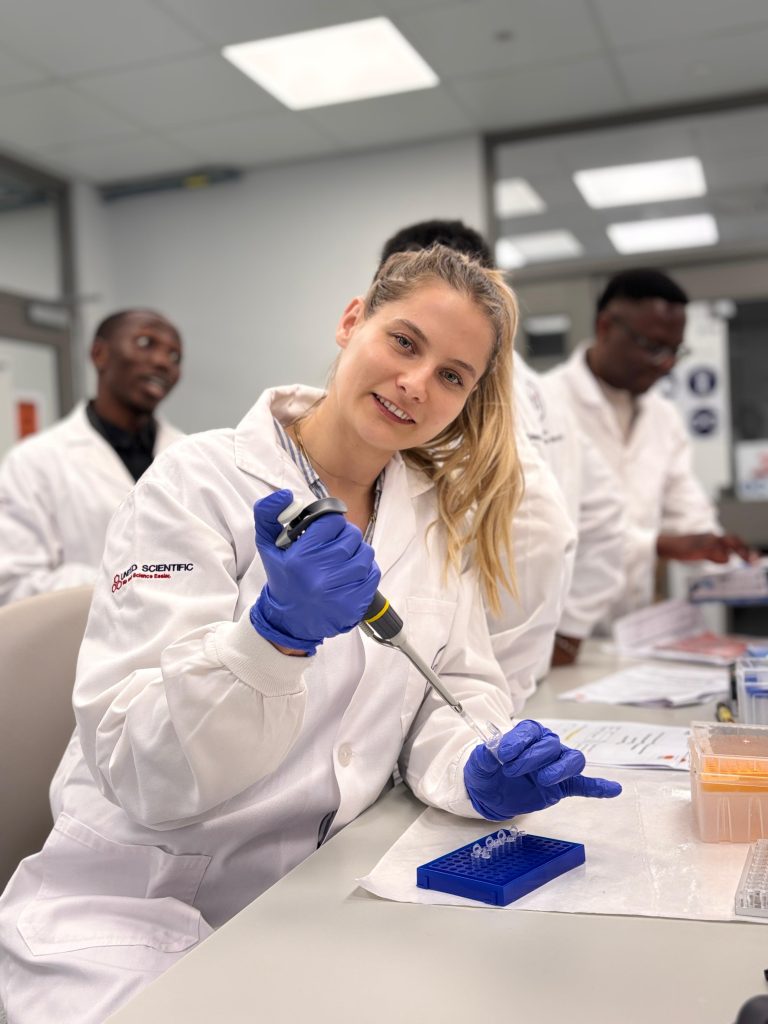
Charleen Wormsberg, ATT African STARS fellow 2025
Access, Application, and ActionÂ
These stories show how the right training, networks, and opportunities enable young scientists to move into meaningful work and extend that impact beyond themselves.Â
From greater confidence and income to a stronger professional voice, the effects build over time. Individual opportunity begins to shape wider systems.Â
This is how potential becomes impact: through access, application, and action.Â
Text: Katrine Anker-NilssenÂ
Photos: CERI Media
News date: 2026-04-07
Links:
KRISP has been created by the coordinated effort of the University of KwaZulu-Natal (UKZN), the Technology Innovation Agency (TIA) and the South African Medical Research Countil (SAMRC).


Location: K-RITH Tower Building
Nelson R Mandela School of Medicine, UKZN
719 Umbilo Road, Durban, South Africa.
Director: Prof. Tulio de Oliveira