KRISP COVID-19 NEWS

Dr. Yuri Munsamy, Science Officer at SACEMA, combines her background in virology with grant development to secure funding for research that shapes public health policy in Africa. She champions collaboration, diversity, and mentorship, encouraging young women to embrace curiosity, persistence, and continuous learning in science.
CERI celebrates Womenâs Day 2025 by highlighting the impactful work of female scientists and professionals leading projects in bioinformatics, grants management, epidemiological modeling, transdisciplinary research, and microbiome studies. Their expertise drives advancements in public health, pathogen research, and scientific innovation across Africa and beyond.

The WEMA project explores the overlooked mental health impacts of climate change in Africa through a community-driven, transdisciplinary approach that blends science, storytelling, and policy. By elevating local voices and experiences, it aims to shape compassionate, inclusive climate adaptation strategies.
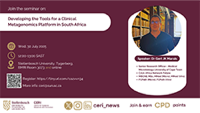
The CERI seminar on 30 July 2025 will showcase Dr Gert JK Maraisâs work developing tailored software and wet-lab protocols to make clinical metagenomics affordable and practical in South African diagnostic labs. Attendee, both in person and online, will learn how these innovations are lowering barriers to comprehensive infectious-disease testing in resource-limited settings.
The Centre for Epidemic Response and Innovation (CER) and GIZ have launched the second phase of their genomic surveillance partnership in Cape Town, securing ZAR 12 million to expande pathogen monitoring, capacity building, and data-sharing across Africa. This phase will broaden surveillance to influenza, RSV, H5N1 and emerging COVID-19 variants while strengthening laboratory infrastructure and integrating genomic insigths into public-health policy.

In this issue, youâll find highlights of a new collaborative program with Germanyâs GIZ to enhance genomic surveillance, updates on the use of AI to predict epidemics, and significant scientific publications on HIV drug resistance and HBV evolution. We also mark Youth Month in South Africa.

This month we published a report that helps to build our understanding of HIV resistance to dolutegravir, the antiretroviral drug that is the cornerstone of HIV treatment across the world.

Hepatitis B virus (HBV) infection is a major public health concern, as chronic HBV infection can lead to liver cirrhosis and increase a personâs risk of developing hepatocellular carcinoma (HCC). HBV has been classified into ten genotypes (A to J). Here, we analysed the genotypic diversity and recombination patterns of HBV using 14486 publicly available HBV genome sequences.

When addressing social issues such as inequality, the climate crisis, or systemic injustices, conventional research methods can fall short of delivering real-world impact. This is where participation and transdisciplinary research step in, not only as buzzwords, but as necessary shifts in how we understand and produce knowledge.

Renowned bioinformatician and infectious disease expert Professor Tulio de Oliveira has been awarded the 2025 EDCTP Scientific Leadership Prize for African men, honouring his outstanding contributions to genomic surveillance, pandemic preparedness, and capacity building in Africa.

Artificial Intelligence is reshaping the world, but alongside its promise comes a growing list of ethical challenges. Carlin Foka, a PhD student researcher at CERI, Stellenbosch University, was selected to attend the Mila Summer School on Responsible AI and Human Rights, held from 26 to 30 May in Montreal, Canada.

Weâre excited to share that Maambele Khosa (Ambie), Head of Communication at the Centre for Epidemic Response and Innovation (CERI), Stellenbosch University, has been named to the Forbes Africa 30 Under 30 list!

Harriet Ngâombe, a PhD student at Stellenbosch University and researcher at the Centre for Infectious Disease Research in Zambia (CIDRZ), presented work on genomic research at the 12th EDCTP Forum in Kigali, Rwanda.

In June 2025, Prof Wim de Villiers and Dr Richard Gordon visited the UK (London and Cambridge) to explore a number of collaboration opportunities. These included the pharmaceutical sector (Glaxo Smith Kline), funding agencies (Wellcome Trust, Childrenâs Innovation Fund Foundation (CIFF)) as well as several UK funding agencies such as UK Research and Innovation (UKRI) and Foreign, Commonwealth & Development Office (FCDO).
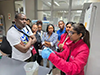
This June, as South Africa commemorated Youth Day, we at KRISP took a moment to reflect on the importance of this dayânot just in remembrance of the past, but in celebration of the present and the promise of the future. Youth Day marks a powerful moment in our nationâs history, honouring the courage of the 1976 student uprisings and reminding us of the role young people continue to play in driving change.
In the last month, our work within the CERI Data Science Unit was showcased across two international discussion panels in Oxford and Berlin contributing to insightful public discourse on pathogen spillover dynamics and AI for infectious disease modelling.
This has been a busy month. In addition to launching three new programs, I also navigated school holidays as a single parent, as my wife was in Portugal to strengthen her Portugueseâessential for her upcoming projects in Lusophone countries. As a result, the release of this edition of the gem came a bit later than usual. That said, itâs a great new issue, packed with timely developments and new grant awards, which are much needed in this era of shrinking global health funding.

The Centre for Epidemic Response and Innovation (CERI) at Stellenbosch University (South Africa) and the Institut Pasteur de Dakar (IPD) (Senegal), in partnership with the Mastercard Foundation, invite applications for the African STARS MBA Fellowship; a fully funded opportunity to pursue a Master of Business Administration (MBA) in Health Care Leadership at Stellenbosch Business School, South Africa

Join this five-day hands-on workshop on metagenomic virus discovery, hosted by global experts in bioinformatics and virology. Gain practical skills in project design, pipeline development, and downstream analysis, including phylogenetics and virus evolution.

In an age where misinformation spreads faster than facts, it has never been more crucial for scientists to engage the public. An open lecture by Prof. Marina Joubert.

On 14 May 2025, CERI hosted an interactive photography workshop in the famous glassenclosed âfishbowlâ boardroom at the School for Data Science and Computational Thinking.
SACEMAâs flaship short course, Introduction to Epidemiological Analysis, recently concluded a successful week of training, equipping participants with essential skills in epidemiological thinking and data analysis. Designed for students, researchers, and public health professionals, the course combined rigorous academic content with hands-on application, delivering a dynamic and impactful learning experience.

Graduation season is upon usâand at KRISP, weâre proudly celebrating the academic achievements of five exceptional team members who have reached major milestones in their scientific journeys.
On Friday, 23 May, KRISP had the honour of hosting 21 enthusiastic Grade 12 learners from KwaMathanda High School, part of the IkamvaYouth Science Track in Umlazi. This inspiring outreach day formed part of KRISPâs broader mission to create meaningful opportunities for young South Africans to engage with science and consider future careers in genomics and research.
In a significant stride toward enhancing next-generation sequencing (NGS) expertise across the continent, the KwaZulu-Natal Research Innovation and Sequencing Platform (KRISP) hosted a comprehensive 7-day Illumina Library Preparation and Sequencing workshop this May. Held from the 6th to the 14th of May at KRISPâs cutting-edge facility, the workshop brought together 15 enthusiastic participants from diverse research backgrounds, all eager to deepen their understanding of NGSâfrom wet lab techniques to data analysis.

The Commonwealth Parliamentary Association (CPA) - UK Branch delegation has come for a high level visit to the Parliament of South Africa on May 1923, 2025, in Cape Town. The visit aimed to deepen relations between the U.K .Parliament and the South African Parliament, with the delegation meeting members of both the National Assembly and the National Council of Provinces.
On 22 May, we at the Centre for Epidemic Response and Innovation (CERI), together with the LaunchLab, officially launched LaunchLab CERIBIO; a new biotechnology laboratory aimed at supporting biotech startups in South Africa. The occasion also marked a major milestone for LaunchLab, which is proudly celebrating 10 years of empowering innovators and entrepreneurs.
We are nearly halfway through the year. A year so dynamic and challenging that it feels more like a decade. It began with the threat of funding cuts to science, which has now become a reality. Just in May, CERI alone lost six NIH grants. Despite these difficulties, we remain committed to doing what South Africa and Africa do best: moving forward with determination and optimism so we can shape our own future.
the gem is a monthly magazine produced by CERI, SACEMA and the Data School at Stellenbosch University and KRISP at UKZN. The objective is to provide stories of world class African science that impact lives and train the next generation of scientists in Africa.

In order to become an organization that value funding raising and career development at every stage and generate the most impactful results and best scientists in Africa. CERI, KRISP & SACEMA are organizing Monthly Fund-Raising Meetings. Prof Tulio de Oliveira & Dr. Cheryl Baxter on June 2025 opportunities.
KRISP COVID-19 TV COVERAGE
COVID-19 | News sub-variant being monitored closely
By: Tulio De Oliveira and CERI and KRISP teams