
Tracking Epidemics Through Wastewater
SACEMA researcher Zinhle E. Mthombothi is among the authors of a new study exploring how wastewater surveillance can be used to track epidemic trends in low-resource settings. Using SARS-CoV-2 data from Gauteng Province, South Africa, the researchers demonstrate that wastewater monitoring can provide valuable population-level insights into disease transmission, even where clinical surveillance data are limited.
The study compared wastewater-based epidemiology with clinical testing data collected over a 21-month period. By analysing wastewater samples alongside reported COVID-19 cases, the researchers assessed whether changes in viral concentrations could provide an early indication of rising or declining infection levels within communities.
Their findings suggest that wastewater surveillance offers a cost-effective and inclusive approach to public health monitoring. Unlike clinical testing, which depends on individuals accessing healthcare services, wastewater surveillance captures information from entire communities, including asymptomatic and unreported infections. This makes it particularly valuable in settings where access to testing may be limited.
The researchers found that wastewater data generally reflected trends observed through clinical surveillance, identifying similar periods of increased transmission and decline. However, the timing and magnitude of these signals were not always perfectly aligned. While wastewater surveillance was effective at tracking overall patterns of infection, clinical testing retained advantages in precisely identifying peaks and changes in transmission dynamics.
The study highlights both the potential and the limitations of wastewater surveillance. Rather than replacing clinical testing, the authors argue that it can serve as a complementary public health tool, providing population-level insights that support disease monitoring and outbreak response. In resource-constrained settings, where large-scale clinical testing may not always be feasible, wastewater surveillance could play an important role in strengthening epidemic preparedness and response.
For access to the full publication, click here
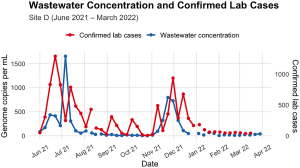
Figure 2 (above): Catchment specific laboratory-confirmed weekly cases and SARS-CoV-2 concentrations in wastewater at Site D, June 2021 March 2022. WW data were collected approximately weekly.
News date: 2026-06-03
Links:
KRISP has been created by the coordinated effort of the University of KwaZulu-Natal (UKZN), the Technology Innovation Agency (TIA) and the South African Medical Research Countil (SAMRC).


Location: K-RITH Tower Building
Nelson R Mandela School of Medicine, UKZN
719 Umbilo Road, Durban, South Africa.
Director: Prof. Tulio de Oliveira