
Advancing Cancer Research
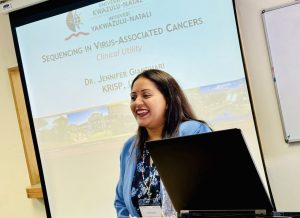
text & photo: Paul Harris
Held in KZN, the symposium focused on moving from epidemiology to intervention – ensuring that scientific insights translate into better diagnostics, treatment strategies, and patient outcomes. Across sessions, a common theme emerged: the need to connect cutting-edge research with the realities of healthcare systems on the ground, especially in high HIV-burden settings where virus-driven cancers are more prevalent.
On the final day of the meeting, Dr Jennifer Giandhari, Head of the KwaZulu-Natal Research Innovation and Sequencing Platform (KRISP), delivered a presentation on sequencing approaches and their clinical utility in cancer diagnosis and prognostication. Her talk highlighted how genomic technologies – once largely confined to research settings – are now playing an increasingly important role in clinical decision-making.
By analysing the genetic signatures of viruses and tumours, sequencing allows clinicians to better understand disease progression, predict outcomes, and tailor interventions. In practical terms, this means earlier detection, more precise treatment strategies, and ultimately improved patient care.
Dr Giandhari’s contribution reflects her longstanding involvement with the International Centre for Genetic Engineering and Biotechnology (ICGEB), and her commitment to advancing genomics research that is both globally connected and locally relevant. Platforms such as this symposium play a critical role in bringing together expertise from across disciplines and geographies to address shared challenges.
The symposium also highlighted the value of collaboration within South Africa and the broader KZN region. “By fostering dialogue between researchers, clinicians, and public health practitioners, these engagements help ensure that innovation is not siloed, but instead translated into actionable solutions that benefit communities and drive collaboration,” said Dr Giandhari.
News date: 2026-06-03
Links:
KRISP has been created by the coordinated effort of the University of KwaZulu-Natal (UKZN), the Technology Innovation Agency (TIA) and the South African Medical Research Countil (SAMRC).


Location: K-RITH Tower Building
Nelson R Mandela School of Medicine, UKZN
719 Umbilo Road, Durban, South Africa.
Director: Prof. Tulio de Oliveira