
Reconnecting Across the WEMA Network
text: Dr Astrid Treffry-Goatley
photos: Supplied by APHRC
After a full day of travel from Cape Town to Johannesburg and finally Nairobi, we set out from Jomo Kenyatta International Airport at dusk, slowly making our way through the dense evening traffic of the city. Leaving Nairobi behind, we joined the busy A104 toward Naivasha a road known for heavy traffic, fast-moving trucks and unpredictable overtaking. As darkness settled, the drive offered glimpses of villages, roadside markets and everyday life unfolding along the route before we finally arrived at the Great Rift Valley Lodge, where colleagues gathered for a late dinner before settling into the tree-top cabins scattered across the property.
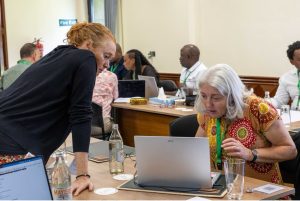
The setting provided the backdrop for several days of meetings, planning and discussion as the WEMA Consortium and Scientific Advisory Board gathered in Naivasha in April 2026. Hosted by the African Population and Health Research Center (APHRC), around 30 researchers and community engagement team (CET) members attended from institutions including the Centre for Epidemic Response and Innovation (CERI), Africa Health Research Institute (AHRI), Comité para a Saúde de Moçambique (CSM), Centre de Recherche en Santé de Nouna (CRSN) and our hosts, the African Population Health Research Centre. I attened with Gill Black and Frank Tanser, on behalf of CERI.
For Gill Black and I, the meeting provided an opportunity to reconnect with the CETs we had worked alongside throughout 2025 during WEMAs digital storytelling (DST) workshops in Kenya, Mozambique, Burkina Faso, and South Africa. The CETs are experienced researchers and facilitators with backgrounds in social science, public health, participatory research, and community engagement, and several hold PhDs. Working across multiple languages and contexts, they have played a central role in leading WEMAs participatory work within their communities.
The DST workshops brought together community-based co-researchers (CBCRs) community members directly affected by floods, cyclones and other extreme weather events to create short digital stories exploring how these events have affected mental health and everyday life.
Since those initial workshops, the CETs have independently continued leading the next stages of the work within their communities. This has included participatory thematic analysis workshops, knowledge exchange sessions and collaborative discussions bringing community members, researchers and scientists together around broader WEMA findings.
One of the notable aspects of the project has been seeing different forms of evidence gradually brought together community stories, prevalence surveys, climate data, systematic review findings, and long-term population health research. A key moment during the consortium meeting was the sharing of emerging findings from WEMAs cross-sectional prevalence surveys being conducted across the four countries. These surveys are exploring levels of depression, anxiety, and post-traumatic stress among populations exposed to extreme weather events. Hearing these early findings alongside the lived experiences reflected in the digital stories highlighted the complexity of climate-related mental health and the importance of drawing on multiple forms of evidence.
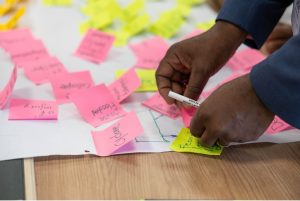
The consortium meeting also marked the transition into the next phase of the community engagement process: systems mapping and brainstorming workshops. During a session led by Collins Iwuji, CETs and researchers from each site worked together to map relationships between extreme weather events, mental health, social vulnerability, and potential interventions emerging through the project.
Using sticky notes, flipcharts and coloured pens, the groups mapped interventions ranging from community-led initiatives and partnerships between communities, NGOs and government structures, to broader state-driven responses. Discussions included peer-support initiatives, youth engagement activities, safer housing advocacy, food security support, mental healthcare access, and disaster preparedness strategies.
The teams then moved into stakeholder mapping exercises, identifying who should be included in the upcoming brainstorming workshops with policymakers, civil society organisations and local decision-makers. The aim is to ensure that ideas emerging through the project can contribute toward practical collaboration and action.
Community engagement is often described as a project activity. In practice, it requires ongoing collaboration, coordination and relationship-building across multiple countries, disciplines, and contexts.
Perhaps most importantly, this meeting highlighted how much WEMA has evolved since the first consortium meeting in 2024, when digital storytelling within the project was still largely conceptual. By the 2026 SAB meeting, the consortium was reflecting not only on completed workshops and emerging findings, but on a collaborative process that now connects community voices, scientific evidence, and stakeholder engagement across multiple African contexts.
Extreme weather is measured through climate data and prevalence surveys. But it is also experienced through uncertainty, displacement, stress, and disruption in everyday life. WEMA continues to explore what becomes possible when these different forms of evidence are brought together.
News date: 2026-06-03
Links:
KRISP has been created by the coordinated effort of the University of KwaZulu-Natal (UKZN), the Technology Innovation Agency (TIA) and the South African Medical Research Countil (SAMRC).


Location: K-RITH Tower Building
Nelson R Mandela School of Medicine, UKZN
719 Umbilo Road, Durban, South Africa.
Director: Prof. Tulio de Oliveira