
Wastewater Insights from Accra
text: SACEMA
photos: Supplied
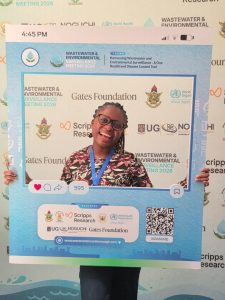
Postgraduate students Comfort Jones and Emmanuel Ahenkan attended the Wastewater & Environmental Surveillance (WES) Meeting 2026, held in Accra, Ghana from 14–15 April 2026. The conference, themed Harnessing Wastewater and Environmental Surveillance: A One Health and Disease Control Tool, brought together researchers and public health practitioners from across Africa and beyond.
The programme spanned two focused days: the first covering scientific applications of wastewater and environmental surveillance – including epidemiological insights, catchment mapping, epidemic preparedness, and multi-pathogen approaches – and the second addressing integration and implementation, with discussions on linkages to clinical surveillance, sustainable scaling, and the future of the field.
For Comfort (pictured below), whose Masters research is directly in this space, the event offered both affirmation and new perspectives. She was struck by the breadth of wastewater surveillance activity across the continent, noting how remarkable the progress has been given the real infrastructure challenges many African countries face, including limited sewer networks and data gaps.
“It was encouraging to see countries such as Ghana and Nigeria increasingly adopting the multi-pathogen approach to wastewater surveillance already well established in South Africa,” said Comfort.
Presentations on wastewater signal interpretation were particularly valuable for her own work, especially in contexts where clinical data is unavailable. She was also pleased to hear talks dedicated to Hepatitis E virus (HEV), her specific pathogen of interest, with case studies from Uganda and Ghana offering new insights. She additionally had the opportunity to connect with colleagues from the NICD who are co-investigators on her research grant.
A key question that stayed with her from the event was how wastewater surveillance can be scaled up and how its findings can be translated into guidance that reaches policymakers and stakeholders.
For Emmanuel, the conference provided an opportunity to engage deeply with current developments in wastewater-based epidemiology and to share his own research. He presented a poster and received valuable feedback from fellow participants, while also spending time exploring other research projects showcased at the meeting.
“I learnt a lot from the presentations and panel discussions, particularly about diverse forms of environmental surveillance and the cost-effectiveness of wastewater-based approaches,” he said. “I also had the opportunity to interact with experts working in this field and build valuable professional connections.”
A particular highlight was participating in a group discussion on the early detection of epidemics – a topic closely aligned with his PhD research. “The discussion was very valuable,” he said. “I contributed to and learnt from conversations on how to reduce the time to detection and response during epidemics and pandemics.”
The experience reinforced the importance of integrating different surveillance systems to strengthen public health preparedness. Reflecting on the meeting, Emmanuel noted that the knowledge, feedback and professional networks gained would directly support his PhD research, particularly in relation to early warning systems, surveillance integration and the interpretation of wastewater data for public health decision-making.
Both researchers highlighted the value of the professional connections made and the broader perspective the conference provided on wastewater surveillance as a public health tool. Emmanuel has also donated his conference book to the SACEMA library so that colleagues can benefit from the latest research and developments in the field.
SACEMA’s attendance was made possible through support from the Gates Foundation. We thank the Foundation for this investment in our researchers’ development and congratulate Comfort and Emmanuel on representing SACEMA at this important regional gathering.
News date: 2026-06-03
Links:
KRISP has been created by the coordinated effort of the University of KwaZulu-Natal (UKZN), the Technology Innovation Agency (TIA) and the South African Medical Research Countil (SAMRC).


Location: K-RITH Tower Building
Nelson R Mandela School of Medicine, UKZN
719 Umbilo Road, Durban, South Africa.
Director: Prof. Tulio de Oliveira