
Unlocking Mageuâs Potential
Mageu is a non-alcoholic fermented cereal drink widely consumed across Southern Africa and traditionally produced through spontaneous fermentation. A new study by Katherine Hartzenberg-Aeroe, Brian Kullin, Jo-Ann Passmore, Anna-Ursula Happel, Hoyam Gamieldien and Marijke Antonia Fagan-Endres explored whether defined Lactobacillaceae starter cultures could provide greater consistency while retaining the qualities of the traditional drink.
The researchers tested five bacterial isolates, both alone and together with Saccharomyces cerevisiae, a yeast associated with mageu fermentation. Importantly, the bacterial strains were originally isolated from healthy South African women and have shown potential as probiotics for womenâs health â raising the possibility of developing mageu with targeted functional applications.
Mageuâs wide consumption, affordability, and cultural acceptance make it particularly interesting for functional food development. Rather than introducing an entirely new probiotic product, the approach could potentially use a familiar and widely consumed beverage as a vehicle for beneficial bacteria, although further research would be needed to establish specific health benefits.
All of the strains successfully fermented the mageu, achieving the acidity required while maintaining viable bacterial populations in the finished product â an important requirement for potential probiotic applications. Mixed cultures containing yeast shortened fermentation time, increased acid production and microbial growth, and were preferred by consumers over the single-strain versions. All of the mageu products also met South African standards for ethanol and solids content.
The findings suggest that defined starter cultures could help modernise mageu production while retaining acceptable sensory characteristics and creating opportunities to diversify the potential functionality of this culturally significant fermented beverage.
Read the full paper here
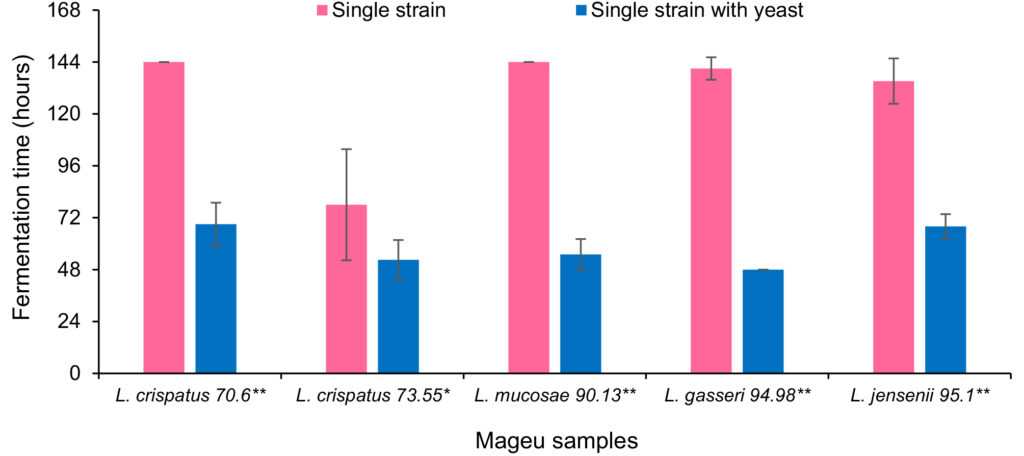
Figure (above):Â Average fermentation times for the mageu samples produced with Lactobacillaceae isolates as single strains and with yeast (* indicates a significance level of p < 0.1 and ** indicates a level of p < 0.001).
News date: 2026-09-03
Links:
KRISP has been created by the coordinated effort of the University of KwaZulu-Natal (UKZN), the Technology Innovation Agency (TIA) and the South African Medical Research Countil (SAMRC).


Location: K-RITH Tower Building
Nelson R Mandela School of Medicine, UKZN
719 Umbilo Road, Durban, South Africa.
Director: Prof. Tulio de Oliveira