
National Research Awards: Professor Tulio de Oliveira Honoured for Societal Impact
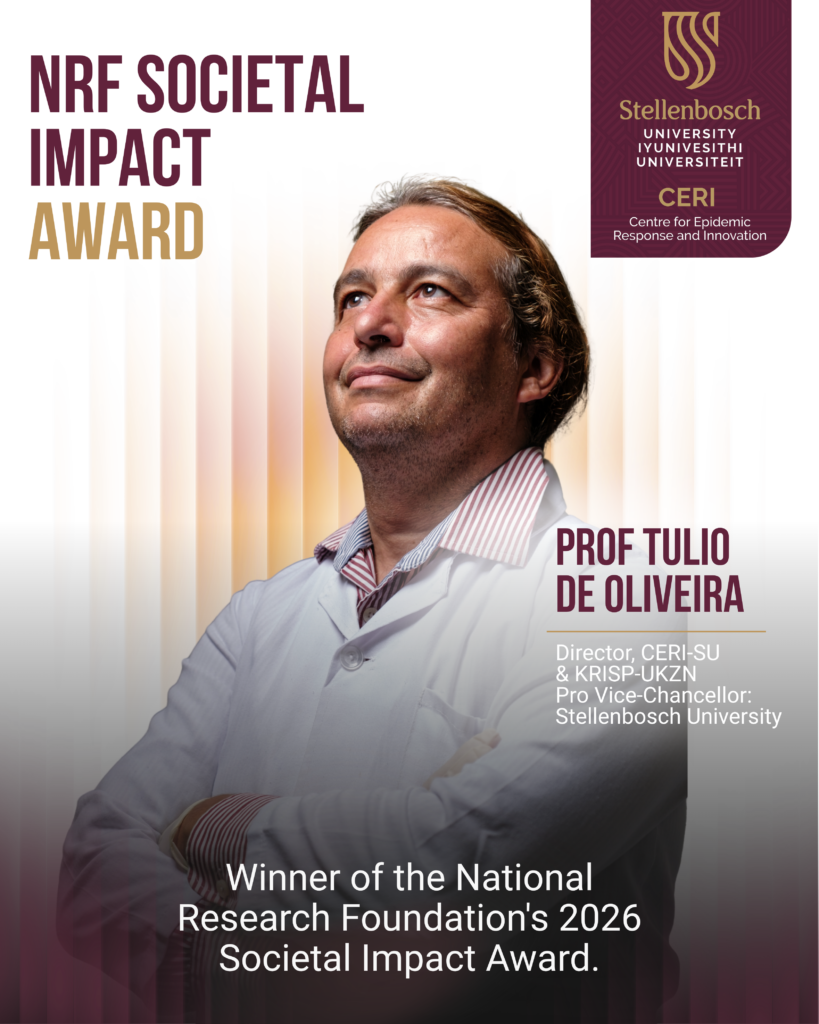
The award was presented at the annual NRF Awards ceremony in Gqeberha last night, Thursday, 3 September, under the theme âBuilding an Inclusive, Impactful and Transformed Research System.â Hon. Professor Blade Nzimande, Minister of Science, Technology and Innovation, delivered the keynote address.Â
The Societal Impact Award recognises NRF-funded or co-funded research that has delivered significant and demonstrable benefits to society through areas including innovation, technological advancement, sustainability and policy development.Â
For Professor de Oliveira, the award recognises more than two decades of work at the intersection of genomics, infectious diseases and public health. As Director of CERI and founder and Director of the KwaZulu-Natal Research Innovation and Sequencing Platform (KRISP) at the University of KwaZulu-Natal, he has helped establish genomic surveillance as a critical tool for identifying and responding to emerging pathogens, while building the expertise, infrastructure and networks needed to strengthen Africaâs epidemic preparedness.Â
âThis award means a lot to me, especially as it recognises the teams at both CERI and KRISP who work day and night to have an impact on society,â said Professor de Oliveira, who is also Pro Vice-Chancellor at Stellenbosch University.Â
âWe are fully committed to advancing science that saves lives, and it is great to see our government, the Department of Science, Technology and Innovation and the National Research Foundation recognise our work with this award.âÂ
Professor Anil Chuturgoon, Acting Deputy Vice-Chancellor: Research and Innovation at the University of KwaZulu-Natal, also congratulated Professor de Oliveira:Â
âUKZN is immensely proud to be associated with Professor Tulio de Oliveira and warmly congratulates him on this significant recognition. Through his pioneering scientific leadership, particularly through KRISP, which he founded and continues to lead, his work demonstrates the power of African science to deliver meaningful impact at home while generating knowledge of global significance.âÂ
CERIâs wider work was also represented among this yearâs finalists. The South African Centre for Epidemiological Modelling and Analysis (SACEMA), which forms part of CERI, was shortlisted for the 2026 Societal Impact Award, having also been named a finalist for the inaugural award in 2024.Â
âCERI and SACEMA work together to advance science that has an impact on society. Our scientists are in close communication with public health officials and policymakers in South Africa, across Africa and at the WHO, helping to guide responses to some of the worldâs deadliest infectious diseases,â said Professor de Oliveira, noting that SACEMAâs recognition was particularly meaningful given the effort to bring leading South African scientists back to the country.Â
âI am personally so proud of SACEMA and Professor Frank Tanser. Four years ago, we convinced him to leave the UK, where he led a top scientific centre, to return to South Africa as Head of Population Health at CERI. He was subsequently appointed Director of SACEMA, which was an NRF Centre of Excellence.âÂ
Professor de Oliveira added: âIt is great to see our work to reverse the brain drain by bringing top South African scientists back to lead organisations such as SACEMA at Stellenbosch University.âÂ
âThese awards tell us something about the kind of research university we are,â said Professor Sibusiso Moyo, SUâs Deputy Vice-Chancellor: Research, Innovation and Postgraduate Studies. âExcellence and relevance are not competing goals at Stellenbosch University. Our researchers are recognised internationally precisely because they take on questions that matter to this country and this continent.âÂ
âThat is what we mean when we commit ourselves to advancing knowledge in service of society,â Professor Moyo added. âI congratulate them, and the students, teams and partners whose work stands behind every one of these awards.âÂ
News date: 2026-09-03
Links:
KRISP has been created by the coordinated effort of the University of KwaZulu-Natal (UKZN), the Technology Innovation Agency (TIA) and the South African Medical Research Countil (SAMRC).


Location: K-RITH Tower Building
Nelson R Mandela School of Medicine, UKZN
719 Umbilo Road, Durban, South Africa.
Director: Prof. Tulio de Oliveira