
Building Genomics Capacity That Lasts
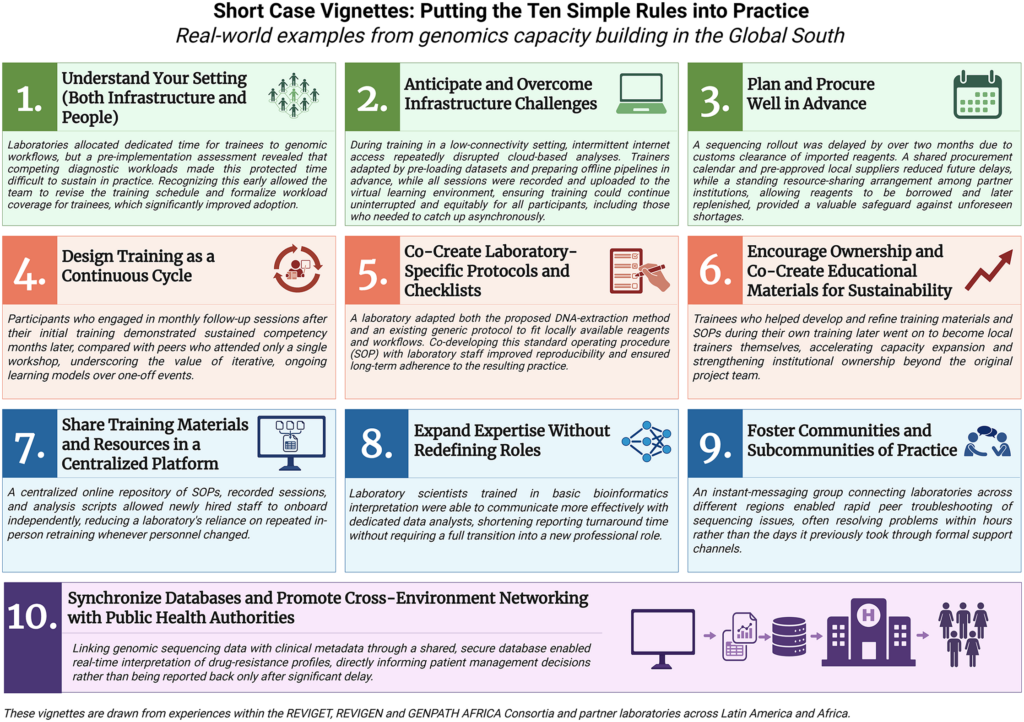
Behind every successful genomics laboratory are people learning new skills, sharing knowledge, overcoming challenges, and finding ways to make sophisticated technologies work in their own settings.
These experiences are at the heart of a new publication co-authored by Dr Emilyn Costa Conceição, a researcher affiliated with the Centre for Epidemic Response and Innovation (CERI) at Stellenbosch University.
Published in PLOS Computational Biology, Ten simple rules to build genomics capacity for routine laboratory practice in the Global South brings together lessons learned through genomics capacity-building initiatives in Brazil and Africa, including the REVIGET, REVIGEN, and GenPath Africa consortia.
The paper, jointly first-authored by Dr Costa Conceição, Abhinav Sharma, and Davi Josué Marcon, explores how laboratories can move beyond individual training programmes and research projects to make genomics a sustainable part of everyday clinical and public health practice.
Genomic technologies are increasingly important for identifying pathogens, monitoring infectious diseases, and supporting public health responses. Yet laboratories in low- and middle-income countries often face challenges involving infrastructure, equipment, procurement, specialist expertise, and institutional support.
The authors emphasise that sustainable capacity building requires more than providing sequencing equipment or organising occasional training workshops. It means understanding the needs of individual laboratories, working with existing expertise, and developing systems that can be maintained locally.
"Behind these ten rules are people learning together, sharing challenges, finding solutions and supporting each other as genomics becomes part of everyday laboratory work," Dr Costa Conceição reflects.
The ten rules address practical considerations, including infrastructure and procurement planning, continuous training, collaborative development of protocols and educational materials, accessible resources, professional roles, and communities of practice. They also emphasise the importance of connecting genomic data with clinical and public health needs.
For Dr Costa Conceição, one of the most meaningful aspects of capacity building is what happens after formal training has ended.
"For me, a particularly meaningful part is the learning that continues after a workshop ends."
She highlights the everyday achievements that demonstrate how knowledge and confidence develop within laboratory teams.
"The colleague who feels comfortable asking for help, the trainee who becomes a trainer, and the team that adapts a protocol and makes it their own. These are achievements worth celebrating too."
This emphasis on continuous learning and local ownership runs throughout the paper, which encourages laboratories to develop the expertise and institutional support needed to sustain genomics independently.
Reflecting on the collaboration between colleagues in Brazil and Africa, Dr Costa Conceição hopes the publication will provide practical guidance for other institutions seeking to establish and sustain their own genomics programmes.
"It makes me happy to see a little of our shared journey between Brazil and Africa reflected in these pages. I hope these 10 rules will be useful to others building and sustaining genomics in their own settings. There is still so much for us to learn together!"
Read full publication here: https://journals.plos.org/ploscompbiol/article?id=10.1371/journal.pcbi.1014863
News date: 2026-11-04
Links:
KRISP has been created by the coordinated effort of the University of KwaZulu-Natal (UKZN), the Technology Innovation Agency (TIA) and the South African Medical Research Countil (SAMRC).


Location: K-RITH Tower Building
Nelson R Mandela School of Medicine, UKZN
719 Umbilo Road, Durban, South Africa.
Director: Prof. Tulio de Oliveira