
Rethinking Foot-and-Mouth Vaccines
By Tshephang Iris Kabelo, African STARS YPP fellow
Imagine waking up to find that a few of your cattle are drooling and limping. Within days, your entire herd is under quarantine, and not a single animal can be sold. The cause is foot-and-mouth disease virus (FMDV), a highly contagious virus that infects cattle, sheep, goats, pigs, buffalo, and other cloven-hoofed animals, both wild and domestic. Although it poses no significant direct risk to people, it can devastate farmers and communities. Commercial producers can lose access to export markets, while small-scale farmers lose the income they depend on to feed their families. For many African households, livestock are their savings, their income, and their future.
While many parts of the world have eliminated foot-and-mouth disease, it continues to circulate in sub-Saharan Africa, the Middle East, and parts of Asia. Recent outbreaks in Southern Africa highlight the scale of the problem. South Africa has experienced successive outbreaks since 2021, with the disease spreading across all nine provinces. By 30 September 2026, 2,871 outbreak events had been recorded, of which 1,501 remained open. The outbreak was classified as a national disaster in February 2026. Botswana, Eswatini, Lesotho, Zambia, and Zimbabwe have also faced economically devastating outbreaks. More concerning still, SAT1, a viral serotype historically associated with Africa, has spread to the Middle East, Europe, and Asia, including regions where livestock may have little or no immunity.
Why is FMDV so difficult to control? The virus has seven distinct serotypes, each containing multiple strains. A vaccine designed for one serotype may not protect against another, and even different strains of the same serotype can vary enough to affect vaccine protection. This means that a farmer can vaccinate every animal against one serotype and still face an outbreak caused by another.
Identifying and characterising circulating strains is therefore essential for understanding the disease and informing vaccination strategies. This is where genomic surveillance becomes important.
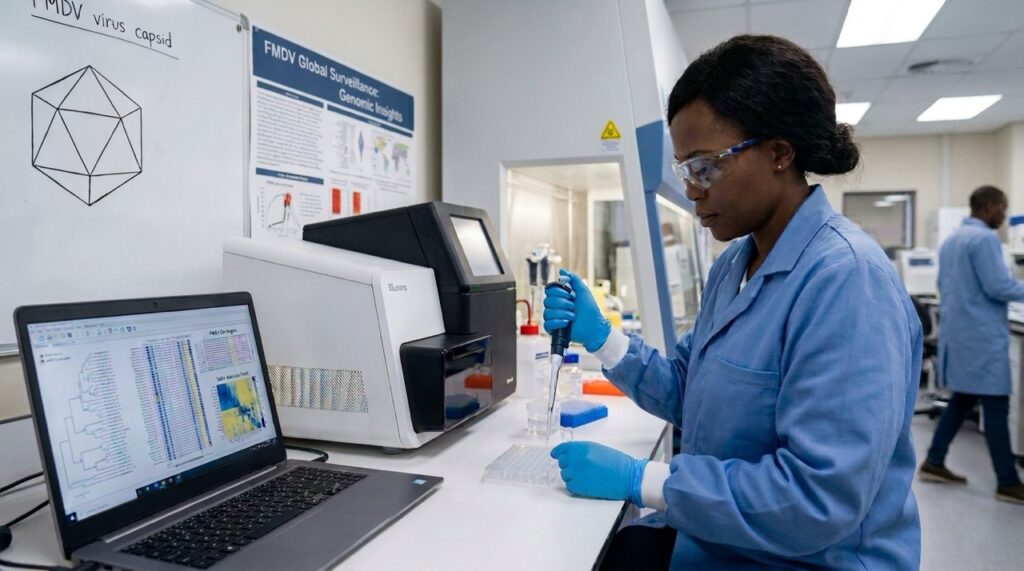
Genomic surveillance involves collecting samples from infected animals, analysing the virus's genetic material, and comparing its genetic sequence with those of other strains. By examining how different strains are related, scientists can track their movement, investigate possible sources of infection, and identify changes in circulating viruses. This information helps explain how the disease spreads and which strains may need to be considered in vaccine development. Genetic information can also be combined with laboratory vaccine-matching tests to assess whether existing vaccines are likely to protect against circulating strains.
A global network of specialist laboratories already shares this information, but surveillance capacity varies across African countries. Many facilities lack the laboratory infrastructure, sequencing equipment, and trained personnel needed to regularly characterise circulating viruses. Because samples often have to be sent elsewhere for testing, access to critical data for outbreak investigations and control decisions is delayed. Strengthening laboratory networks, sample collection systems, and regional data sharing is therefore essential for improving Africa's ability to monitor FMDV.
Understanding which strains are circulating is only part of the challenge. We also need vaccines that protect against them and sufficient supplies to respond to outbreaks.
Recent outbreaks have highlighted the pressure on regional vaccine supply systems. In South Africa, shortages and delays in vaccine availability meant that the country had to rely on imports. At the same time, the Botswana Vaccine Institute (BVI), an important regional vaccine supplier, saw demand increase as outbreaks spread across the region. BVI has indicated that regional requirements have reached at least 43 million doses, compared with an optimal production capacity of approximately 25 million doses. This illustrates the difficulty of meeting regional vaccine demand during widespread outbreaks.
Most FMDV vaccines currently used are made from whole viruses that are grown and then inactivated, or killed, so they cannot cause disease. Although effective, their production requires specialised facilities, strict safety measures, and careful refrigeration during storage and transport.
This is where my own research comes in. I am interested in investigating African FMDV strains as potential candidates for virus-like particle (VLP)-based vaccines.
VLPs are essentially empty virus shells. They resemble the virus closely enough for the immune system to recognise them and produce antibodies, but they contain no viral genetic material and cannot cause infection.
By using African FMDV strains to develop VLP vaccine candidates, my research explores approaches to vaccine development that account for the diversity of viruses circulating on the continent. An important part of this work is producing and characterising these particles to understand their potential as vaccine candidates. This research contributes to the broader effort to investigate alternative approaches to FMDV vaccine development.
Controlling FMDV requires more than identifying circulating strains. Vaccines must provide protection against those strains and reach livestock before outbreaks spread further. Strengthening genomic surveillance, regional laboratory collaboration, and research into alternative vaccine technologies could help Africa respond more effectively, protecting livestock, livelihoods, and food security.

Sources
- https://www.nda.gov.za/images/outbreaks/Foot%20and%20Mouth%20Disease%20Outbreak/Reports/2026/2026-09-30-fmd-technical-report.pdf
- https://www.woah.org/en/article/the-spread-of-fmd-to-new-areas-is-concerning-but-consequences-could-be-worse/
- https://portlandpress.com/biochemist/article/43/4/18/229402/Small-is-beautiful-virus-like-particles-as
- https://www.fli.de/en/news/short-messages/short-message/the-first-mrna-vaccine-against-foot-and-mouth-disease-successfully-tested-in-cattle-by-fli-as-part-of-an-international-collaboration/
- https://www.westerncape.gov.za/agriculture/article/western-cape-welcomes-president-ramaphosas-announcement-foot-and-mouth-disease-fmd-national
- https://www.woah.org/en/article/the-spread-of-fmd-to-new-areas-is-concerning-but-consequences-could-be-worse/
- https://www.gov.bw/vp-tours-bvi-fmd-threat-looms
News date: 2026-11-23
Links:
KRISP has been created by the coordinated effort of the University of KwaZulu-Natal (UKZN), the Technology Innovation Agency (TIA) and the South African Medical Research Countil (SAMRC).


Location: K-RITH Tower Building
Nelson R Mandela School of Medicine, UKZN
719 Umbilo Road, Durban, South Africa.
Director: Prof. Tulio de Oliveira