
Beyond The Diagnostics
text & photos: Center for Africas Resilience to Epidemics (CARE) at the Institut Pasteur de Dakar
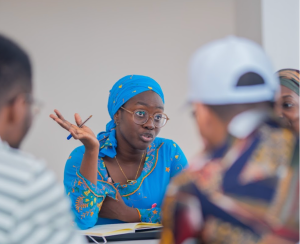
For Marième Samb Traoré, a Technology Transfer Specialist at Institut Pasteur de Dakar and African STARS Young Professional Fellow from Senegal, the fellowship did more than deepen scientific knowledge. It reinforced a core principle: health innovation in Africa must be designed for implementation, not just efficacy, within existing systems and at population scale.
Before joining African STARS, Marième had already built hands-on expertise in developing and validating rapid diagnostic tests and supporting technology transfer toward production. She did not enter the fellowship as a beginner. She entered it as a scientist ready to broaden her impact. I was already working in the field of in vitro diagnostics, focusing on the development and validation of rapid diagnostic tests. My role involved managing different stages of product development, including design, analytical performance evaluation, and technology transfer toward production.
What drew her to African STARS was the chance to strengthen skills that sit beyond the laboratory, but are essential to public health change. What motivated was the opportunity to develop my skills in innovation, project structuring, and strategic thinking, she says. I was particularly drawn to the fellowships focus on empowering African scientists to address local health challenges with locally adapted solutions. This strongly resonated with my ambition to contribute not only to the development of diagnostic tools, but also to shaping how they are effectively deployed in real-world settings.
The fellowship combined technical training with broader exposure to innovation, entrepreneurship, grant writing, and storytelling. For Marième, that multidisciplinary design mattered because it pushed fellows to connect science to implementation. The first four months were structured as an intensive training phase covering key areas such as biosafety and biosecurity, advanced genomics, grant writing and storytelling, as well as vaccine and diagnostic R&D and manufacturing, alongside innovation and entrepreneurship, she says. One of the key highlights was the exposure to a network of African professionals working across different disciplines. The diversity of perspectives was extremely valuable and helped me better appreciate the complexity of health challenges, as well as the importance of multidisciplinary approaches in addressing them.
One of the clearest shifts in Marièmes perspective is her growing attention to what happens after an innovation is developed. She describes entrepreneurship, project structuring, and scientific communication not as secondary skills, but as central to turning science into impact. These discussions helped me better understand the pathway from scientific development to real-world impact. They also pushed me out of my comfort zone by encouraging me to think beyond technical execution and engage with broader questions such as impact, scalability, and sustainability, she says adding that she strongly believes that these skills are essential for scientists not only to develop innovations, but also to clearly communicate their value and articulate the impact they can have in real-world settings.
Marièmes strongest reflection is also the most important one. She does not describe the fellowship as simply helping her improve. She describes it as helping her see more clearly what meaningful innovation requires in the African context. The most important lesson I took away from this fellowship is that creating an innovation itself is not enough. It is essential to develop solutions that are not only scientifically sound, but also practical, affordable, and scalable, she notes. This is especially true in the African context, where factors such as access, infrastructure disparities, and cultural aspects must be carefully considered.
One of the main outputs of Marièmes fellowship was the development of a project on a multiplex rapid diagnostic test designed to simplify the workflow for healthcare workers. What matters most is how she now thinks about the project: not only in technical terms, but through the lens of accessibility and scale. This process allowed me to go beyond the technical aspects and think more concretely about funding, implementation, accessibility, and how such a solution could realistically be deployed at scale in low-resource settings.
Overall, she says, this experience has strengthened my ability to translate technical ideas into practical, scalable solutions that can contribute meaningfully to expanding access to healthcare across Africa.
Perhaps the most revealing part of Marièmes testimony is what surprised her most: the real barriers to healthcare access are often not a lack of ideas, but the wider ecosystem around them. The difficulty in accessing healthcare is often not due to a lack of ideas or innovation. Rather, it stems from the need for scientists to better understand and engage with other critical dimensions such as leadership, policy and regulatory frameworks, health system integration, supply chain, user needs, as well as aspects like marketing, commercialisation, and fundraising.
That statement captures the broader significance of her story. Building resilience to epidemics requires scientists who can do more than innovate. It requires scientists who can navigate the systems that shape whether innovation becomes access.
When Marième speaks to future applicants, her advice is simple but telling: If you are looking to expand beyond your current role and gain a broader perspective on how your work can create impact, this fellowship is a very valuable opportunity. It is not just about gaining knowledge, but about challenging how you think, how you approach problems, and how you position yourself as a contributor to change.
Asked to describe African STARS in one word, she chose: Transformative. For CARE, that transformation is not only personal. It points to the kind of African scientific leadership needed to strengthen public health systems: technically strong, strategically grounded, and committed to solutions that are practical, scalable, and built for context.
The African STARS Fellowship Programme is implemented by CARE at Institut Pasteur de Dakar and CERI at Stellenbosch University, with support from the Mastercard Foundation.
News date: 2026-05-13
Links:
KRISP has been created by the coordinated effort of the University of KwaZulu-Natal (UKZN), the Technology Innovation Agency (TIA) and the South African Medical Research Countil (SAMRC).


Location: K-RITH Tower Building
Nelson R Mandela School of Medicine, UKZN
719 Umbilo Road, Durban, South Africa.
Director: Prof. Tulio de Oliveira