
Turning Data into Public Health Decisions
text: Jeremy Bingham & Shadé Horn
photo: Supplied
The vision of the SACEMA Policy Modelling Fellowship is to foster a more informed, agile response to epidemics in Africa in which interventions are backed, where possible, by widely available data. We are building towards a future where key epidemiological analysis and modelling takes place in-country and is driven by close relationships between policy makers and government-affiliated analysts.
Through the 10-month fellowship, SACEMA trains, mentors, and supports fellows to develop modelling insights with real-world impact. Fellows focus on vaccination programme optimisation, population immunity estimation, and outbreak risk analysis, developing and delivering modelling insights in conversation with government stakeholders and decision makers. The fellowship is a journey of collaboration between the fellowship coordination team at SACEMA, AIMS Senegal, and the fellows themselves. While the fellowship coordination team leads the training and model selection aspect of the work, the fellows are the key players in their engagement with stakeholders. Only working together can we achieve our mission.
The SACEMA Policy Modelling Fellowship prepares fellows to provide key insights to decision makers, including insights related to vaccination planning and decision making in resource-constrained scenarios. For example, fellows have the opportunity to examine the age profiles of measles and polio immunity in their countries, bringing together a range of datasets, and to estimate the effectiveness of different supplemental immunisation activities.
The third cohort of SACEMA Policy Modelling fellows are currently hard at work. Fellows are engaging with stakeholders in their home countries, across Africa, to identify appropriate policy questions, access key epidemiological data, and build relationships for ongoing collaboration.
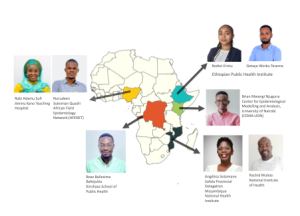
Simultaneously, each fellow is working through a personalised series of courses, reading papers, attending talks, and engaging in group discussions, all aimed at strengthening their technical skills and expanding their epidemiological knowledge. The 2026 cohort consists of 8 fellows from Nigeria (2), Ethiopia (2), Mozambique (2), Kenya, and DRC, with five fellows focused on measles and three fellows focused on polio.
As the global community marked World Immunisation Week (2430 April), the urgency of this work is clear. International funding for vaccination and public health has become increasingly uncertain, and we must collectively face the fact that the substantial progress made to combat serious vaccine-preventable diseases, such as measles and polio, is not guaranteed, and is maintained only by sustained effort. The value of data-driven targeting, prioritisation, and planning to maintain or increase effectiveness with fewer resources is clearer than ever.
In mid-June, fellows will travel to South Africa to participate in the Clinic on Meaningful Modelling of Epidemiological Data (MMED), hosted at AIMS South Africa in Muizenberg. This two-week modelling clinic emphasises the use of real-world data in understanding infectious disease dynamics and serves as a key step before fellows begin working with immunity estimation methods at SACEMA.
Following MMED, fellows will spend four intensive weeks at SACEMA in Stellenbosch. During this time, they will adapt established modelling approaches to their own country data and produce preliminary outputs. After returning home, they continue refining their analyses, while developing policy briefs and preparing presentations for stakeholders and decision-makers.
Fellows will return to SACEMA in October for a further two-week visit to consolidate results, finalise policy briefs, and strengthen their stakeholder presentations. Dissemination meetings will take place in November and December, when fellows will present their findings to stakeholders in their home countries.
These final dissemination meetings are central to the fellowships purpose. Fellows address key policy questions, such as how best to allocate limited resources, which population groups are most at risk, and how disease surveillance systems can be strengthened. The aim is to provide clear, usable evidence that informs planning and decision-making.
The SACEMA Policy Modelling Fellowship also recognises that becoming a confident and independent disease modeller takes longer than one year even an intensive programme such as this is only the beginning.
SACEMA therefore connects fellows to a broader network of partners, working to make continued mentorship and support available beyond the fellowship itself.
Across Africa, disease modellers applying data-driven methods with a policy focus remain scarce. Effective modelling depends on teams who are not only technically skilled, but who also have access to data, understand local realities, and can effectively collaborate with decision-makers and other stakeholders.
Through our collaborative approach, the SACEMA Policy Modelling Fellowship is helping ensure that locally-owned data provides maximal benefit to Africas public health stakeholders, and that world-class analysis and modelling services are available to stakeholders at critical moments.
News date: 2026-05-13
Links:
KRISP has been created by the coordinated effort of the University of KwaZulu-Natal (UKZN), the Technology Innovation Agency (TIA) and the South African Medical Research Countil (SAMRC).


Location: K-RITH Tower Building
Nelson R Mandela School of Medicine, UKZN
719 Umbilo Road, Durban, South Africa.
Director: Prof. Tulio de Oliveira