
Asking More Of Health Data
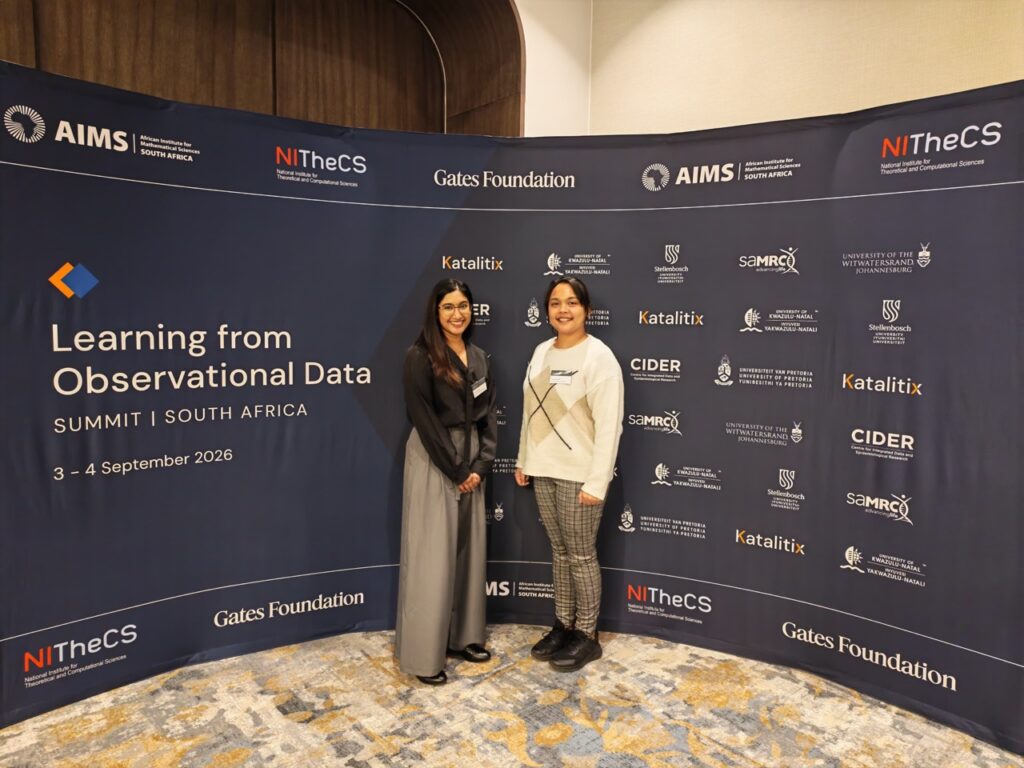
Clinical trials are often considered the gold standard for determining whether a treatment or intervention causes a particular health outcome. But what happens when conducting a randomised trial is not feasible?
For Tammara Poa Siang Koh and Thenuja Pillay, the Learning from Observational Data Summit offered an opportunity to explore how researchers can approach these questions using data that already exist.
The summit, hosted by Katalitix and led by Professor Ruth Keogh from the London School of Hygiene and Tropical Medicine and Wim Delva, combined conceptual teaching with hands-on workshops, coding walkthroughs, and discussions around real-world health-data challenges.
A central focus was target trial emulation – an approach that starts by defining the randomised trial researchers would ideally conduct and then uses observational data to emulate that trial as closely as possible.
For Tammara, a PhD candidate at the South African Centre for Epidemiological Modelling and Analysis (SACEMA) and the Centre for Epidemic Response and Innovation (CERI), the framework provided a particularly useful way of thinking about causal questions.
“The main idea that stayed with me was target trial emulation: starting by specifying the randomised trial one would ideally like to run, and then using observational data to emulate it as closely as possible,” she says. “I found this a very clear way to structure causal questions and make the assumptions behind an analysis more explicit.”
That means thinking carefully about questions such as who would be eligible for a study, what intervention is being investigated, how treatment would be assigned, how long participants would be followed, and what outcome would be measured – before beginning the analysis.
For Tammara, this has direct relevance to her own research. “In my hepatitis B modelling work, much of the evidence comes from observational and serological data, so this framework is useful for distinguishing descriptive inputs and calibration targets from evidence intended to support a causal claim.”
For Thenuja, the summit similarly shifted how she thinks about the possibilities contained within observational data. “It made me see observational data as more than a source of associations or patterns,” she says. “With the right methods and careful assumptions, it can be used to investigate causal relationships and generate credible evidence.”
More broadly, the experience was a reminder that limitations in available data do not necessarily mark the end of a research question.
“When clinical trials are not feasible, it doesn’t necessarily mean the answer to a causal question ends there,” Thenuja says. “There may be a more appropriate or advanced method that allows us to explore these important questions rigorously.”
Both participants also highlighted the value of moving between theory and practice during the summit.
Tammara found the applied nature of the training particularly useful. “The combination of conceptual teaching, code-based examples and discussion made causal inference – and trial emulation in particular – feel more concrete and relevant to real-world health-data questions.”
For Thenuja, the value extended beyond the technical training to the people and conversations surrounding it. “Beyond the technical learning, I valued being surrounded by people who are passionate about using data to address real-world health challenges,” she says, “and being exposed to enlightening discussions aimed at informing better solutions and decisions in healthcare.”
Together, their reflections point to a broader lesson from the summit: learning from observational data is not simply about having more data, but about asking clearer questions, understanding the assumptions behind an analysis, and choosing methods that allow existing data to provide meaningful evidence.
text: Katrine Anker-Nilssen
photo: Supplied
News date: 2026-10-05
Links:
KRISP has been created by the coordinated effort of the University of KwaZulu-Natal (UKZN), the Technology Innovation Agency (TIA) and the South African Medical Research Countil (SAMRC).


Location: K-RITH Tower Building
Nelson R Mandela School of Medicine, UKZN
719 Umbilo Road, Durban, South Africa.
Director: Prof. Tulio de Oliveira