
Rewriting Africa’s Disease History
For decades, the story of humanity’s ancient diseases has been told largely through bones and DNA recovered in Europe, Asia and the Americas – leaving out the very continent where our species, and its long relationship with infectious disease, began.
A new review by researchers from Uppsala University and CERI – the Centre for Epidemic Response and Innovation – aims to change that. Mapping what ancient pathogen genomics has revealed so far, the paper also makes the case for continent-wide ancient pathogen screening to uncover Africa’s deep infectious disease history.
“Africa’s long history of infectious diseases, reflected in the burdens of tuberculosis, cholera, typhoid, malaria and schistosomiasis, together with genomic evidence pointing to an African origin of the Mycobacterium tuberculosis complex ancestor, motivates continent-scale ancient pathogen screening,” says CERI Director Prof Tulio de Oliveira, a co-author of the review. “Ancient pathogen genomics is important to understand how diseases emerge and how to prevent them. It normally involves archaeology and access to samples preserved in teeth, bones and mummies.”
Highlights
Ancient pathogen genomics has transformed infectious-disease history, yet Africa remains severely underrepresented despite its central role in human evolution, biodiversity, and pathogen emergence.
Evidence from Eurasia and the Americas shows that dated pathogen genomes can overturn models of origin, transmission, and dispersal that were previously inferred from modern data alone.
African ancient pathogen evidence is largely limited to Egyptian remains, and only one sub-Saharan metagenomic study to date has reconstructed an ancient Rickettsia felis genome from an approximately 2000-year-old child from Ballito Bay, South Africa.
With rapidly improving biomolecular methods and a growing interest in Africa’s disease history, the coming years are likely to transform our understanding of ancient pathogens on the continent and their long-term impacts on African populations.
Read the full paper, and list of authors, here
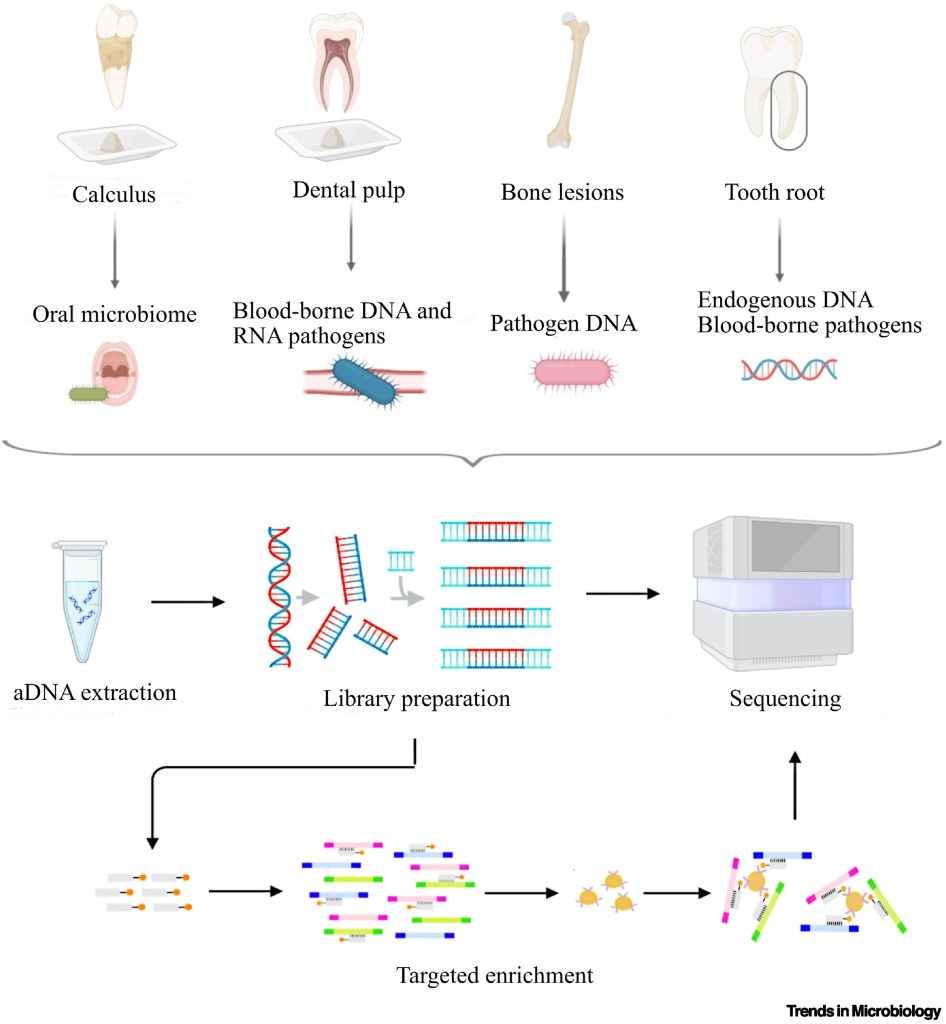
Figure 1 (above): Sources and workflows for ancient pathogen genomics.
Ancient pathogens can be detected from multiple biological substrates, including dental calculus, dental pulp, skeletal lesions, and tooth roots. Following ancient DNA extraction, libraries are prepared for shotgun sequencing or targeted enrichment to increase pathogen recovery. Downstream bioinformatic analyses enable the identification, authentication, and genomic reconstruction of bacterial, viral, and eukaryotic pathogens from archaeological remains. aDNA: ancient DNA.
News date: 2026-07-30
Links:
KRISP has been created by the coordinated effort of the University of KwaZulu-Natal (UKZN), the Technology Innovation Agency (TIA) and the South African Medical Research Countil (SAMRC).


Location: K-RITH Tower Building
Nelson R Mandela School of Medicine, UKZN
719 Umbilo Road, Durban, South Africa.
Director: Prof. Tulio de Oliveira