
Tracking Rift Valley Fever
Researchers analysed nearly 600 Rift Valley fever virus genomes collected between 1944 and 2022 to better understand how the virus evolves as it circulates between livestock, wildlife and humans. Led by PhD candidate, Isaac Emmanuel Omara and colleagues from CERI and the International Livestock Research Institute in Kenya, the study found that the virus has remained remarkably genetically stable over time.
“What surprised me most was how purifying selection has conserved most of the Rift Valley fever virus genome over decades, despite the virus circulating across diverse hosts and regions in Africa,” said Omara. “At the same time, we identified a small number of sites under diversifying selection in the viral polymerase and glycoprotein genes, suggesting these may represent key adaptive changes.”
He said the findings reinforce the importance of continued genomic surveillance. “While RVFV remains genetically stable overall, continuous genomic surveillance is essential to detect emerging variants with the potential to alter transmission, host adaptation or vaccine effectiveness before they contribute to future outbreaks.”
The adaptive mutations identified in the study could also help guide the development of broader vaccines. “These mutations highlight regions where the virus may be evolving in response to host immune pressure,” Omara explained. “By combining these evolutionary findings with immunoinformatics and AI-based structural modelling, we hope to identify vaccine candidates with the potential to provide broad protection against genetically diverse RVFV strains circulating across Africa.”
The work comes at a critical time, as climate change, expanding mosquito habitats and increasing livestock movement create new opportunities for Rift Valley fever virus to spread. “Monitoring RVFV evolution helps detect emerging variants early, informs vaccine and diagnostic development and supports strategies that protect both public health and food security,” said Omara.
Read the full paper, and list of authors, here
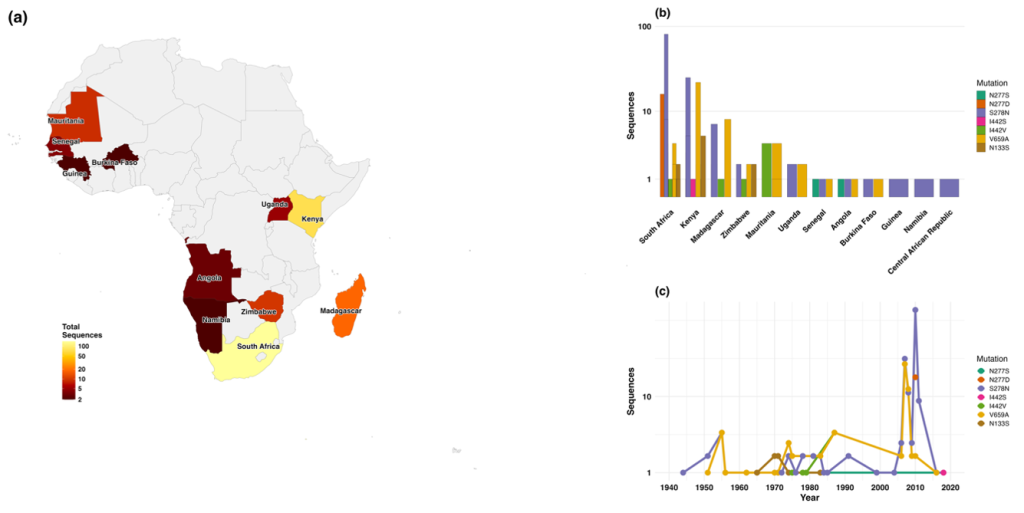
Figure (above):
a) Geographic distribution of sequences carrying at least one of these candidate adaptive mutations across Africa, while b) illustrates the country-level distribution of individual adaptive amino acid substitutions.
News date: 2026-07-30
Links:
KRISP has been created by the coordinated effort of the University of KwaZulu-Natal (UKZN), the Technology Innovation Agency (TIA) and the South African Medical Research Countil (SAMRC).


Location: K-RITH Tower Building
Nelson R Mandela School of Medicine, UKZN
719 Umbilo Road, Durban, South Africa.
Director: Prof. Tulio de Oliveira