
Beyond the Lab Coat
Growing up in Umlazi, Xolani Zulu had a clear picture of his future. Inspired by a childhood doctor's kit bought for him by his mother, he was convinced he would one day become a doctor. Although his career eventually took a different path, his desire to make a difference in people's lives has remained at the heart of everything he does.
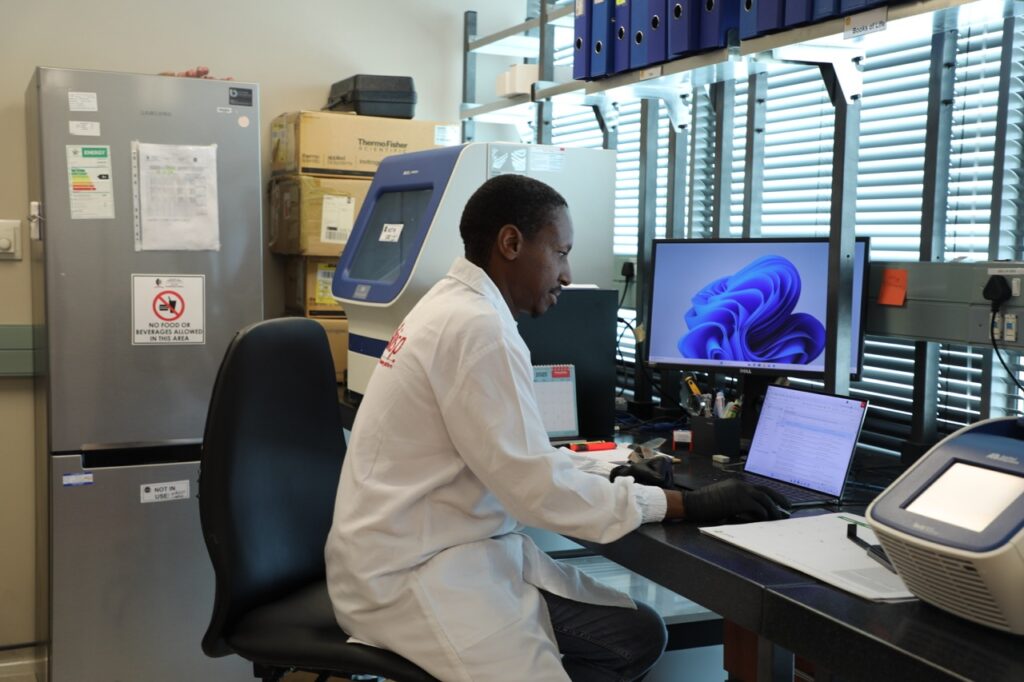
As a skilled laboratory technician at the KwaZulu-Natal Research Innovation and Sequencing Platform (KRISP) at the University of KwaZulu-Natal (UKZN), Xolani plays an important role in ensuring the accuracy and reliability of HIV drug resistance testing. His work requires technical expertise, meticulous attention to detail, and a steady hand under pressure. Yet his greatest reward is knowing that his efforts can help someone receive the care they need.
Raised in Umlazi by his mother, grandmother, and aunt, Xolani remembers his childhood fondly. Surrounded by family and friends, he enjoyed exploring different parts of the township, sometimes disappearing for most of the day until the neighbourhood joined the search for him. His grandmother kept him in line, occasionally with a stern reminder of who was in charge, but those early years helped shape the person he is today.
His childhood ambitions were firmly rooted in medicine. However, his university admission points did not allow him to pursue a medical degree. Instead, he enrolled in Biomedical Science at the Mangosuthu University of Technology (MUT), a second choice that would ultimately open the door to a rewarding career in laboratory science.
His interest in science had already developed at high school, where he particularly enjoyed Physical Science, Mathematics, and Biology. He also admired his Physics teacher, whose knowledge of the subject inspired him and strengthened his appreciation for science.
What began as an alternative route became a fulfilling professional journey, demonstrating that an unexpected change in direction can lead to a meaningful career.
Xolani began his professional career in 2005 in the Virology Department at Inkosi Albert Luthuli Central Hospital (IALCH). There, he gained experience in serology, molecular testing, and cell culture, building the technical foundation that would serve him throughout his career.
He later joined Addington Hospital, where he helped establish a new laboratory for viral load testing and worked towards accreditation through the South African National Accreditation System (SANAS).
In 2023, he joined KRISP, where he contributes to HIV drug resistance testing and helps maintain compliance with the ISO 15189:2022 medical laboratory quality standard.
His responsibilities extend well beyond performing tests. Receiving samples, conducting laboratory procedures, maintaining equipment, managing documentation, and supporting colleagues all contribute to the delivery of reliable results.
For Xolani, the purpose behind these responsibilities is clear.
"I get satisfied and proud when I send the results report to the client, knowing that someone will get help in their sickness all because of the effort I have put," he explains.
It is this connection between laboratory work and its potential impact on people's lives that gives his role meaning. Although the scientific processes take place out of public view, their importance extends far beyond the laboratory.
Working in a laboratory demands precision, consistency, and the ability to remain calm when things do not go according to plan. Xolani has learnt that managing these moments is just as important as mastering the technical aspects of his work.
One of his biggest challenges has been overcoming the fear and panic that can arise when something goes wrong. His approach is to remain calm, keep moving forward, and remind himself that difficult moments will pass.
"I have taught myself to be patient and to be calm no matter the circumstance," he says, adding that prayer before beginning his working day has played an important role throughout his journey.
This perspective has shaped not only his approach to work but also his relationships with those around him.
At KRISP, he values working alongside talented scientists who are approachable, supportive, and willing to help. He also appreciates the opportunity to learn from colleagues with different backgrounds, cultures, and perspectives, recognising that working towards a common goal requires understanding and respect for others.
His contribution extends beyond the tests he performs. Throughout his career, he has helped train numerous staff members, many of whom have developed into capable professionals. It is an achievement he takes pride in, knowing that even a small contribution to another person's journey can make a lasting difference.
Away from the laboratory, Xolani enjoys spending time in his garage, working on tools and small engines he has collected over the years. It offers a different kind of problem-solving, allowing him to put his practical skills to use in his own time.
His greatest joy, however, comes from spending time with his youngest daughter, Lisakhanya, aged six. As a father of three daughters, Olusha, 19, Ndalo, nine, and Lisakhanya, six, family remains central to his life and his hopes for the future.
When asked what he hopes to achieve over the next five to ten years, his answer reflects the values that have guided him throughout his journey. Above all, he wants to be a good role model and father to his daughters, helping them grow into independent young women who can stand on their own feet.
Professionally and personally, he hopes to continue growing, learning from others, and offering a helping hand wherever he can.
The young boy who once imagined himself treating patients as a doctor has found another way to contribute to people's well-being, through the precision of laboratory science, the knowledge he shares with colleagues, and the care he brings to his responsibilities.
For Xolani Zulu, making a difference is not about being in the spotlight. It is about doing his work carefully, helping others along the way, and recognising that even the smallest contribution can have a meaningful impact.
And that is a lesson that extends well beyond the lab coat.
Text and photos: Paul Harris
News date: 2026-10-27
Links:
KRISP has been created by the coordinated effort of the University of KwaZulu-Natal (UKZN), the Technology Innovation Agency (TIA) and the South African Medical Research Countil (SAMRC).


Location: K-RITH Tower Building
Nelson R Mandela School of Medicine, UKZN
719 Umbilo Road, Durban, South Africa.
Director: Prof. Tulio de Oliveira