
Postdoctoral Research Fellow in Mucosal Immunology and Genital Health
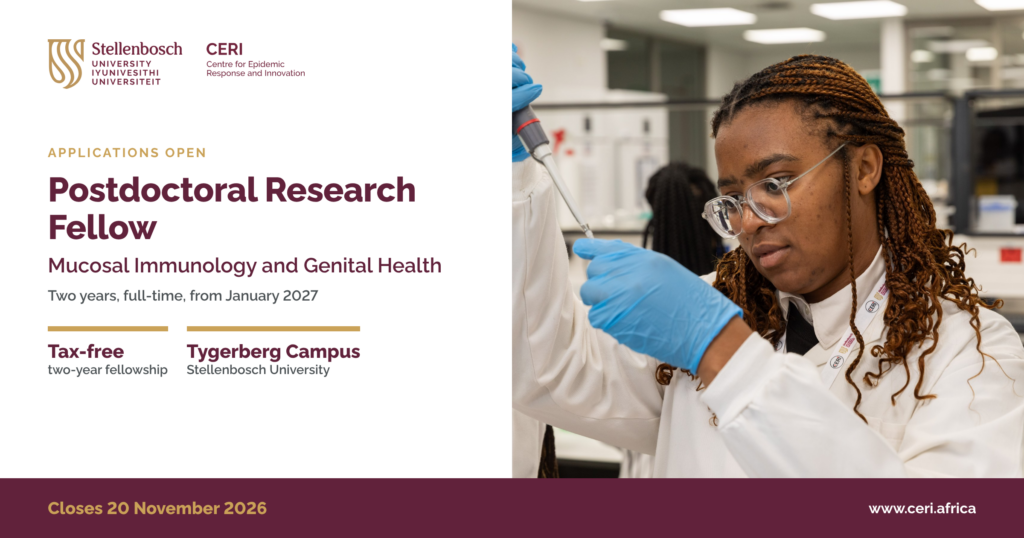
The Centre for Epidemic Response and Innovation (CERI) at Stellenbosch University invites applications for a two-year, tax-free postdoctoral fellowship in mucosal immunology and genital health. The fellow will be based at CERI in the Biomedical Research Institute, Tygerberg Campus, Stellenbosch University.
The role
The fellow will carry out laboratory research to inform the development of vaginal formulations that support mucosal health and meet women’s needs and preferences. Working with human vaginal epithelial cell models, the fellow will investigate how formulation components affect epithelial barrier integrity, inflammation, tissue repair and interactions with microorganisms.
Responsibilities include developing and validating assays, conducting experiments, analysing and managing research data, and preparing publications and progress reports. The fellow will work with national and international partners to integrate biological findings with materials science and user acceptability research.
Who can apply
Applicants need a PhD awarded within the last three years, preferably in immunology, cell biology, molecular biology, microbiology, biomedical sciences or a closely related discipline. Preference will be given to South African applicants. International applicants are welcome to apply.
Essential
- Mammalian cell culture and aseptic laboratory experience
- Experience in epithelial biology, inflammation or host-microbe interactions
- Competence in cellular and molecular assays such as immunofluorescence, qPCR, Western blotting or cytokine measurement
- Experimental design, troubleshooting, quantitative analysis and accurate research documentation
- Scientific writing ability and research outputs appropriate to career stage
- Ability to work independently and collaborate across disciplines
Advantageous
- Primary human epithelial cell or vaginal epithelial model experience
- TEER, epithelial junction analysis and scratch/wound-repair assays
- Reproductive or mucosal immunology experience
- Microbial adhesion or pseudovirus assay experience
- Glycocalyx, mucin, glycan or biomaterials research experience
- Analysis of donor-based experiments using mixed-effects models
How to apply
Apply online by Friday 20 November 2026: Apply here
Please upload your CV, motivation letter, research statement, academic record, publications list and contact details for referees.
Interviews will take place from 23 to 27 November 2026. Shortlisted candidates will be informed of the outcome in the second week of December.
Fellowship details
- Tax-free fellowship
- Duration: two years, full-time, from January 2027 to December 2028
- Renewable subject to additional funding for project expansion
- The successful candidate may start virtually and take up the position in person one or two months later if needed
- Supervisor: Prof. Lenine Liebenberg, Chief Researcher: Immunology, CERI, Stellenbosch University
Queries
Prof. Lenine Liebenberg, via ceri@sun.ac.za
News date: 2026-11-02
Links:
KRISP has been created by the coordinated effort of the University of KwaZulu-Natal (UKZN), the Technology Innovation Agency (TIA) and the South African Medical Research Countil (SAMRC).


Location: K-RITH Tower Building
Nelson R Mandela School of Medicine, UKZN
719 Umbilo Road, Durban, South Africa.
Director: Prof. Tulio de Oliveira