
Tracing Rift Valley Fever's Journey Across Africa
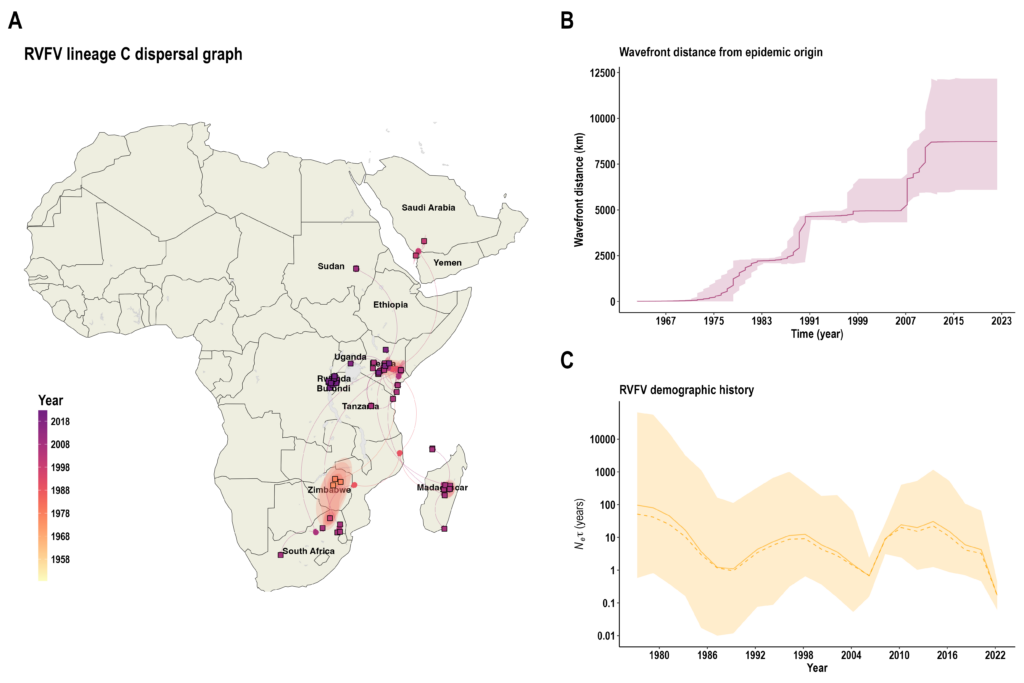
ABOVE: Figure 3 - (A) Reconstructed geographical dispersal of lineage C across Africa and the Arabian Peninsula, with colours indicating the estimated timing of viral movement. (B) Estimated expansion of the geographical wavefront from its epidemic origin over time. (C) Changes in the estimated effective viral population size over the past five decades. Shaded areas represent uncertainty intervals.
The most widespread lineage of Rift Valley fever virus (RVFV) may have originated in Zimbabwe in the mid-1970s before making its way across Africa and eventually reaching the Arabian Peninsula. Its journey, reconstructed through a new genomic study, reveals a history of long-distance movement, unexpected speed, and continued viral activity even during years without recognised outbreaks.
Published in The Lancet Microbe, the study was led by Dr John Juma of the International Livestock Research Institute (ILRI), with collaborators including researchers from the Centre for Epidemic Response and Innovation (CERI) at Stellenbosch University. It examined the geographical spread and evolutionary history of RVFV, with particular attention to lineage C.
"Across the longer history, the picture is of a virus with a home base and long-distance reach," says Dr Juma. "East Africa – Kenya in particular – sits at the center of onward spread in the region."
Yet lineage C appears to have emerged further south. The researchers traced its probable origins to Zimbabwe in the mid-1970s, followed by its arrival in Kenya in the early 1980s, Madagascar in the 1990s, South Africa around 1999, and the Arabian Peninsula in the early 2000s. More recently, the lineage has reached Uganda, Rwanda, and Burundi.
Its movement was not continuous. Instead, the analysis identified periods of increased geographical spread, with major outbreaks and expansions occurring at intervals of approximately 10–15 years.
"So the virus appears to sit in a region, then make a long jump," Juma explains.
The speed of its geographical spread was among the study's most surprising findings. Estimated diffusion rates exceeded 50,000 km² per year, far greater than the researchers had anticipated for a virus transmitted by mosquitoes and associated with animal movements.
An even more significant finding challenged their understanding of what happens between outbreaks.
"We went in assuming the virus more or less pauses between outbreaks. It doesn't," says Juma. "Lineage C kept accumulating changes and splitting into new sublineages right through the quiet interepidemic periods. We had thought of those years as a gap in virus's story. They are part of it."
This suggests that the absence of reported outbreaks does not necessarily mean the virus has disappeared. Instead, it may continue circulating and diversifying without being detected.
"It suggests that the virus is still there and still changing when no outbreak is being reported – and we are almost blind to it, because active surveillance is lacking," Juma explains.
For countries where lineage C is endemic, these findings have practical implications. Regular sampling between outbreaks could provide an earlier indication of viral activity and help inform decisions about livestock vaccination before seasonal outbreaks cause significant losses.
"The practical implication is that surveillance triggered by outbreaks is always too late by design," Juma says.
The study offers a different perspective on Rift Valley fever's history, demonstrating that the years between outbreaks are an important part of understanding how the virus persists, evolves, and spreads.
Abstract
This retrospective genomic epidemiology study investigated the evolutionary history, geographical spread, and environmental drivers of Rift Valley fever virus across Africa. Researchers combined newly generated viral genomic sequences with publicly available data and applied phylogenetic and spatial modelling techniques.
The findings identified lineage C as the most widely distributed lineage, with a probable origin in Zimbabwe in the mid-1970s. The analysis revealed rapid geographical expansion, ongoing genetic diversification, and evidence of viral evolution during periods between recognised outbreaks.
The study highlights the potential for lineage C to establish endemic transmission in new regions and emphasises the importance of continuous genomic surveillance, particularly during periods of undetected circulation.
Read full publication here: https://doi.org/10.1016/j.lanmic.2025.101251
News date: 2026-11-03
Links:
KRISP has been created by the coordinated effort of the University of KwaZulu-Natal (UKZN), the Technology Innovation Agency (TIA) and the South African Medical Research Countil (SAMRC).


Location: K-RITH Tower Building
Nelson R Mandela School of Medicine, UKZN
719 Umbilo Road, Durban, South Africa.
Director: Prof. Tulio de Oliveira